Showing posts with label Archbishop Collins. Show all posts

Wednesday, January 15, 2014

Lectio Divina


Dear Theophilus,


Inspired by Archbishop Cardinal Collins, lately I have come into the practice of Lectio Divina as a part of my daily prayer life. This has grown out of a desire to read and meditate on the daily readings set out by the Church. 


An ancient tradition, dating back to Origen in the Third Century Lectio Devina can be simply translated as either Holy or Sacred Reading, referring to one reads and meditates on Sacred Scripture. This understanding of Lectio Devina is reiterated by Cardinal Collins in the introduction to his book Pathway to our Hearts, where he is quick to point out that Lectio Devina should not be approached as a course in Bible study (exegis). Although Cardinal Collins recognizes that Scripture study is important, he reminds us that Lectio Divina is meant to be a prayerful encounter with our living God through the inspired word of Sacred Scripture. 


There is no official format for Lectio Divina, however, there are certain elements that will help one get the most out of this spiritual practice. Reading, prayer, meditation and contemplation are all a part of Lectio Divina, however, the order you do these in depends on the amount of time you have to dedicate to Lectio Divina and finding a formula that works best for you. Since I can only dedicate 15 minutes to my daily Scripture reading (unlike the 45 minute Lectio Divina sessions Cardinal Collins offers monthly at St. Michael’s Cathedral in Toronto), I follow the simple formula of prayer, reading, and then combine my meditation and contemplation. 


I start with prayer to focus my mind and settle my heart. I find that this helps me ready myself to receive the Word of God and to meditate on how He is speaking to me. The prayer is usually quite simple, I either allow the Holy Spirit to guide my prayer: Lord, please allow me to hear your will for me today in your word; or I will recite the words of the prophet Samuel: Speak Lord, your servant is listening. If I am feeling particularly agitated, I may even recite a decade of the Rosary. 


My heart and mind ready to listen to the Lord, I turn to the passage I have chosen to read that day. I usually read the Bible readings for the day, but there are other times when I feel I need to return to Sunday’s Gospel throughout the rest of the week; and still other times there is a particular passage that I feel is pertinent to my life right now. Since Lectio Divina is meant to be a prayerful encounter with God through Scripture I read the passage slowly and out loud, imagining that I am proclaiming the Word at Mass. I let the Word linger on my lips, savouring what God is saying. Searching for what God is trying to tell me. 


This is where meditation and contemplation on the Word comes in. I will often read, re-read and read the passage again. There will be key phrases and words that jump off the page for me. There are times when I have returned to a reading and God has prompted my attention in a new direction, peeling back the layers of his will for me. Usually I am surprised by how there is something in the reading that speaks directly to something going on in my life. I have even laughed out loud when the Lord has offered me a solution to a problem that I had not thought of, but with His help seems so obvious. 

I will then finish my meditation with an Our Father, Hail Mary and Glory Be.


My Lectio Divina complete, I find renewed strength to take on the day. I take courage in knowing that God has a plan for me, and that I am setting out to do His will.


Friday, January 10, 2014

Every Mass is like High Mass


Dear Theophilus,

As a family we like to start school breaks (Christmas and summer) with a little get-a-way. We find our holidays to be more relaxing because there is a distinct break between work and down time with the forced relaxation that a hotel stay brings. It’s nothing extravagant, just a couple of nights in a hotel with a pool in downtown Toronto, with someone to make the beds, cook meals and do the dishes for few days.

Each year one of the highlights is attending High Mass at St. Michael’s Cathedral.

One of the reason’s my son likes going to the cathedral because his name is also Michael, so he feels a certain link with the church, like it’s his very own. He also likes looking for the Archbishop’s tasselled hat hanging above the altar. And the look of awe in his eye when he saw Thomas Cardinal Collins processing in was only matched by his excitement when he realized we would received communion from his Eminence.

Personally, I find a certain enchantment with the sacred beauty that Mass at the cathedral entails. There is all of the sacred art – murals, stained glass, the gold gilded tabernacle; which all focus the mind towards God (unfortunately all hidden behind restorers’ scaffolding on our December visit). When the 100-voice strong choir from the acclaimed St. Michael’s Boys’ Choir School sang the Gloria, I closed my eyes and imagined that this must be as close as earthly possible to the Angels’ refrain on the night of the Nativity. Added to this was the sweet scent of incense, and I felt that I was participating in something sacred.

I was so moved and excited by the whole experience, shortly after Mass I sent a text message to a friend: High Mass at the Cathedral with the Cardinal. AWESOME!!!!!!

To which he replied: Very cool … our Mass parish priest … no power … still awesome …


I was dumbfounded. He was so very right! Yes, all the sacred beauty and enchantment of the cathedral Mass are wonderful, but what is truly awesome, the source and summit of our faith, is the Eucharist. Whether it is celebrated on the altar of the humblest of chapels or under the Dome of St. Peter’s in Rome, the core of the Mass is the same. We are called to partake in Christ’s sacrifice in the Eucharist. AWESOME!!!!!

Monday, February 11, 2013

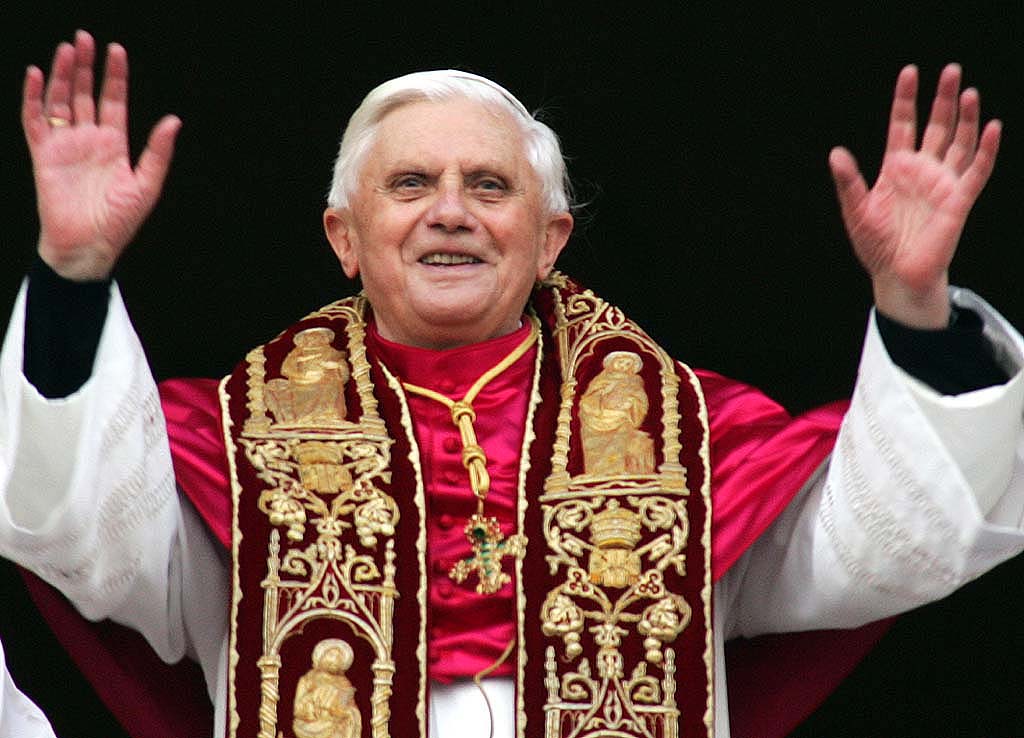
Benedict XVI - Thank You, Danke, Grazie, Merci


Dear Theophilus,

This morning, Pope Benedict XVI announced his abdication from the Papacy. I'm sure that this will be a happy day for many liberal Catholics, as well as many who like to attack the Catholic Church and what they think it represents. On the other hand, it is a sad day for many Catholic's of a more conservative nature, like myself, because of the uncertainty of the direction the conclave will take.

I don't think there were any surprises with Benedict XVI's pontificate. As Cardinal Ratzinger and Prefect for the Congregation of the Faith, Benedict XVI was already quite well known for his traditional views of Churhc doctrine - views that many seem to have forgotten that were also held by the grandfatherly Blessed John Paul II. When I think of those who criticized Benedict XVI for his teachings on Life, Marriage and the Ordination of women, I think of something Toronto Archbishop Cardinal Collins once said: "Perhaps the majority of Catholics have some difficulty accepting the teaching of Church on some issues - that doesn't make them right."

From the time of Christ, the Catholic Church has always been, and probably always will be, counter-cultural. We need to give a prayer of thanksgiving for men such as Benedict XVI who are strong enough and wise enough to continually point towards the Truth of divine revelation.

Please join me, dear Theophilus, in praying that the conclave to choose the next successor to St. Peter will allow itself to be guided by the Holy Spirit to do God's will here on earth.

Monday, September 3, 2012

Thoughts on the Year Ahead in my Catholic Classroom


Classroom in catholic school in Argentina Stock Photo - 2629500

Dear Theophilus,

Although I like to take time on Labour Day weekend to look back at the blessings that summer vacation has brought: a new puppy to our family, Michael’s week at Totus Tuus, and the many hours spent together as a family; I also like to use the week and days leading up to a new school year to reflect on the possibilities that lie ahead to set myself a goal as a Catholic teacher.

This year I would like to make the Catholic Education in my classroom just that, more Catholic.

I came to this decision for a number of reasons and from a number of different angles.

Firstly, Pope Benedict has declared this to be the Year of Faith for the Catholic Church starting in October 2012. I can’t think of a better way to celebrate the Year of Faith than by deepening my own faith and helping others to deepen their own. Of course this is a part of my job description as a Catholic Educator, but a lot of times faith takes a backseat to curriculum in my classroom.

Secondly, one of the instructors from my summer course on religious education directly challenged us to put into words how our Catholic classrooms are different from the classrooms of the public school across the street. When it comes right down to defending Catholic education, he told us, this would be the question posed in court – how are Catholic schools (and their classrooms) different. Many of my colleagues would begin to talk of Gospel values and social justice, but I fear that our public counterparts would be able to make the same claims under citizenship and moral ethics. In my History and Geography classroom I want to teach Catholicism from its core so my students can articulate what Catholic teachings are founded on and where Catholic teachings can take us to make a better society for everyone.

Thirdly, I had the wonderful opportunity this past summer to meet with Cardinal Archbishop Collins of Toronto. His Eminence was so gracious in his demeanour and so passionate about Catholic education that I couldn’t help but be moved by the same passion to infuse my Catholic classroom with faith.

Finally, publicly funded Catholic education in Ontario seems to be under attack more now than ever before. With our provincial government braying for cutbacks to public education expenses, one of the first items on many cost-effective lists is the amalgamation of Catholic school boards with their public (secular) counterparts. Yes, duplicity does seem unnecessarily expensive on the surface, but at what cost to the moral fabric of society by removing Catholic teaching out of the public forum (here it seems as though I return to my second argument – we need to show how Catholic education is not only different, but beneficial). This will be all the more important in Ontario Catholic schools this year as Gay-Straight Alliances promise to make their appearance in our schools and Catholic teaching will come under direct media scrutiny.

What do I propose to do?

I know I cannot change the system, nor my style, overnight and that baby steps are needed. I hope to make signs of our Catholic faith more visible in my classroom. I’m also re-inventing some of my assignments to reflect Catholic social teachings, their history and their guiding principles. For example, when we study the development of the social movement in Canada (workers’ rights, women’s suffrage, etc.) or the unequal distribution of global wealth, I want to challenge my students to find what the Catholic Church teaches on these subjects through papal encyclicals. I also intend on becoming more involved in the chaplaincy program at school with the goal of helping increase a sense of the sacred for my students – taking Catholicism beyond simple social justice.

Will I be a roaring success in changing the tone of Catholic education? I hope so, but I doubt it. I know that there will be times when I succeed, but there will also be times when I fail in the knowledge and courage needed to carry out God’s calling as a Catholic teacher. It’s for those times when I falter that I ask you to pray for me and the students entrusted to my care.

Tuesday, July 31, 2012

On Pilgrimage


Dear Theophilus,

I’ve just finished reading Hilaire Belloc’s The Path to Rome. It’s the story of the narrator’s pilgrimage from Lorraine in north-east France along a direct line to Rome. In a descriptive style typical of the late XIX Century the narrator describes his journey as he climbs over mountains and wades through rivers crossing France, Switzerland and Italy. The classical digressions aside, like many pilgrimages, Belloc’s Path to Rome is as much about the journey as it is the destination.

Reading about Belloc’s journey got me to thinking about how the pilgrimage seems to have become a lost art among Catholics. Living in a world that is driven by material success, very few people have the luxury of taking the time off to walk across a continent, and even fewer are willing to make the sacrifice. But those who do will tell you that the sacrifice is will worth it.

I’ve been blessed enough to have been able make the journey to a number of pilgrimage sites. Some exotic and far flung, while others were not as famous and quite close to home.

In 2003 my wife and I visited Europe for 3 weeks on our summer holidays. With a list of sites to see and thousands of kilometres to travel a rental car, instead of the traditional hiking boots, was our only option. First on our list of stops was Lourdes. I had read a couple of articles about St. Bernadette and the grotto at Lourdes, but I really wasn’t ready for what I experienced. I felt a truly spiritual sense of sacred tranquility as I knelt and prayed in the grotto where Our Lady appeared to St. Bernadette. It is impossible to put into words the sense of sacred presence that permeates that holy place.


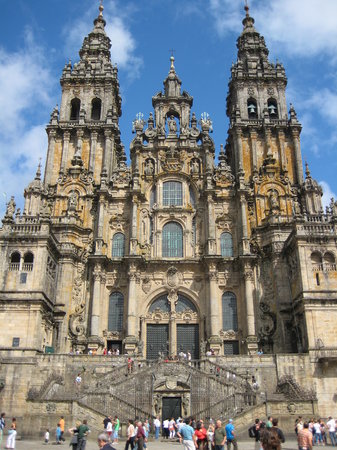
Perhaps this experience at Lourdes was the reason for my disappointment in Santiago de Compostela. Even though it was years before Emilio Estevez’s The Way – in 2003 the Camino still held a certain celebrity cache as far as pilgrimages go. Visiting the cathedral and kneeling at the tomb of St. James, I couldn’t help but wonder at what the hype was all about. Like I said, a pilgrimage is as much about the journey as it is about the destination; and I think this holds true in the relationship between the Camino and Santiago.


My wife’s family is Portuguese, so she spent her entire childhood hearing about the visions at Fatima, so this central Portugal town was out next pilgrimage destination. We some how managed to time our visit with High Mass on Sunday, standing in the square in front of the cathedral with 10,000 other pilgrims under the sun of one of Europe’s worst heat waves on record. The most moving experience came at the end of mass when the statue of Our Lady of Fatima (the assassin’s bullet in her crown) was recessing back to the chapel at the other end of the square as 10,000 pilgrims began waving goodbye to her with white handkerchiefs. It was as though we were saying goodbye to a close and dear relative, knowing we would always be in her prayers.


Our tour ended back in France with a visit to friends who live just north of Lyon. Before leaving Canada, a colleague had suggested that we visit the tomb of St. Jean Vianney in the village of Ars if it was on our route. Much to my amazement, a quick internet search showed that Ars is only 10km from our friend’s town. Even more amazing was that our friends had never been there before. They tagged along to see if it would be worth bringing other guests to visit the Curé d’Ars, my wife and I enjoyed watching the transformation of our friends’ children who were being raised without religion but had a million-and-one questions as they tried to seek out their own personal faith.

Since 2003, pilgrimages have become a part of our vacation travels, many of them much closer to home. We have taken our son to Martyrs Shrine and Ste. Marie Among the Hurons (Midland, Ontario) to pray at the tombs of St. Jean de Brébeuf and St. Gabriel Lalement. Last summer we spent a day at St. Joseph’s Oratory in Montréal, a trip that inspired Michael to build a church out of Lego “Just like St. André.” Our simplest pilgrimage was to St. Michael’s cathedral in Toronto to listen to Thomas Cardinal Collins give the homily. That visit was as much about explaining the cathedral, the Archbishop’s hat hanging over the altar, the vestments and the sense of sacred as incense wafted into the air, as it was about meeting our dominical obligation in an extraordinary way.

Making a pilgrimage, near or far, famous or ordinary, is a great expression of our Catholic faith. As a family we are always looking for a new pilgrimage destination and would love to read your suggestions. As you leave on your pilgrimage, however, remember that it’s as much about the journey as it is the destination.

Saturday, January 7, 2012

Announcing Archbishop Thomas 'Cardinal' Collins


Dear Theophilus,

I’ve always found it amusing that the Archbishop of Toronto shares his name with a cocktail – Tom Collins (though I believe his grace prefers to go by the name Thomas). It was announced yesterday that Archbishop Collins can add another mixed drink to his name, that of Cardinal (a French drink of liqueur de cassis and red wine).

At the consistory announced for February 18 and 19, 2012 Archbishop Collins will become a Prince of the Church with 21 other new Cardinals (read the announcement here).

In some ways, Archbishop Collins’ inclusion can be seen as a political move for the Catholic Church in Canada. Firstly, recent tradition has had the Archbishop of Toronto presiding as a Cardinal (Gerald Emmett Cardinal Carter and Aloysius Cardinal Ambrozic in my memory). Also, since the Archdiocese of Toronto is the largest within Canada it is fitting that its head be named a Cardinal. Finally, of Canada’s other two Cardinals (Jean-Claude Cardinal Turcotte of Montreal and Marc Cardinal Ouellet of Québec City), Cardinal Ouellet was called to the Vatican in 2010 to assist in the naming of bishops, opening the need for another Cardinal to represent Canada.

I’ve had the pleasure to hear Archbishop Collins preach at St. Michael’s Cathedral, and he came across as a man of both the Church and the Congregation. Holding a doctorate in theology, with a specialty in sacred scripture, there is no denying Archbishop Collins’ credentials. That said, the way in which he addressed his flock showed how he understood where we are on our faith journey and how best to shepherd us along. There was a common touch to his words.

Coming back to Archbishop Collins sharing his name and title with mixed drinks, perhaps these can be seen as appropriate monikers for a man of Christ. When he says Mass daily, Archbishop Collins says the following when he mixes water in wine in the chalice: “By the mingling of this water and wine may we come to share in the divinity of Christ who humbled himself to share in our humanity.”

Humble – there is another great adjective to describe a gentleman who likes his Timbits. (read the National Post article this is mentioned in here)

May God bless Archbishop Collins, the Light of Christ shine through him and the Holy Spirit guide him as he takes the red hat.