Showing posts with label Christmas. Show all posts

Wednesday, December 20, 2017

Having a Mary (not a Martha) Christmas


Dear Theophilous,

Each year Christmas seems to blow our home through like a tornado… There’s a low dark rumbling that grows in intensity through December that culminates in a whirlwind of family visits, a race to open presents and a multicourse gourmet meal on Christmas day. Once the dust has settled my wife and I will collapse amidst the stacks of dirty dishes, the detritus of shredded gift-wrap and already forgotten toys, our glazed eyes asking, “What just happened?”

What just happened (what tends to happen every year) is a Martha Christmas. Not a Martha Stewart Christmas, but a Martha Christmas, as in the sisters Mary and Martha whom Jesus visited (cf Lk 10:38-42). When Jesus visited the sister’s home, Mary sat at the feet of Our Lord, hanging on every word he said, while Martha was distracted by her many tasks. (Lk 10:40)

Too often this is what happens to us during the Advent and Christmas seasons – we are distracted by our many tasks in bringing the holiday together for others. There are presents to buy, lists to be made to make sure no one is forgotten, a house to be cleaned, a tree to be decorated, a meal to be planned, groceries to be bought, a turkey to be stuffed and the trimmings to be fixed – the distractions can be endless. The temptation to become Martha can be overwhelming.

When all is said and done at the end of Christmas day, which are the memories we will want to cherish – running around the kitchen or laughing with family? fighting the crowds at the mall or holding our children, their faces lit up from the simplest of gifts? Wouldn’t we much rather have been like Mary, sitting at the Lord’s feet and listening to what he was saying (Lk 10:39), relishing in his presence in those around us, than running around distracted like Martha, missing out on what is really important.

This isn’t to say that we need to completely abandon the trappings of Christmas – absolutely not, they are very much a part of celebrating the Lord’s birth; we just need to be careful not to let the distractions of the season take over. Too often at festive family gatherings, one or two people do all the running around while the rest sit back and enjoy. Just as Martha begrudged Mary sitting at Jesus’ feet, we too can begrudge being sucked in by the distractions of the day and not being able to enjoy the Christmas merriment.

There is a time and a place for festive preparations, but we shouldn’t let them take over. In the years that come, we won’t recall every gift that was given or received, but we will cherish the memory of the laugh we shared with family and friends. The greatest gift we can give each other is our time and presence, these things don’t run on batteries, nor will they fade, shrink or give us heartburn – they will give us joy.


This year at Christmas, we need to recognize those special moments when Christ comes into our life through others, and like Mary, we need to chose the better part, which will not be taken away from us. (cf Lk 10:42)

Friday, December 1, 2017

Advent - a Mini-Lent


Dear Theophilous,

As the calendar turns over to December and the malls fill with Christmas decorations, we are reminded of the joyful warmth that Christmas brings. There are office parties to go to, neighbours to have over, as well as family and friends to reconnect with over food, drinks and gifts.

Yet the Church is clothed in a mournful purple, and the Scripture readings remind us of God’s final judgement and call us to forgo the pleasures the season embraces. What gives?

Unfortunately, in all of the hubbub that surrounds our preparation for Christmas, we tend to forget why Christ came in the first place – to save us from our sins.

Keeping this in mind, every year I try to make my Advent a mini-Lent in an attempt to prepare my heart for the true meaning of Christmas. I try to incorporate the three pillars of Lent: Prayer, Fasting and Almsgiving into my Advent life.

The funny thing is, the craziness of the pre-Christmas season actually lends itself to making Advent a kind of mini-Lent.


Prayer

December always seems like a whirlwind. There are gifts to buy, friends and family to see, and Christmas concerts to attend. One would think that it’s pretty much impossible to keep a prayer life, let alone deepen it.

When I begin to feel overwhelmed I take a mental step back, a deep breath and create a personal bubble of silence in the busy world. A simple prayer of thanksgiving – for the child who’s concert I’m squeezed into a stuffy gym for, the ability to buy gifts in a mall full of grumpy shoppers, for the job which I leave for and come home from in the dark.

Prayer life in Advent doesn’t need to be monastic; it can be quite simple, and as such, it can give us the strength to meet the festive flurry head-on.


Fasting

Diet in December… impossible, but fasting can be made easy. Culinary temptation is all around us in the lead up to December 25th; the call to fast reminds us to enjoy this time of year simply and responsibly.

Fasting is Advent doesn’t need to be a complete giving up of food, luxurious treats or drink. Fasting can happen through out your normal daily life: a simpler and healthier breakfast, a small lunch (perhaps one made at home instead of from the food court), and only one helping at dinner. When it comes to all of the yummy nibbles at Christmas socials, taking just one or two, instead of three or four or more, will let you be both socially polite yet aware of our need to fast from overindulgence.


Almsgiving

At first glance, the lead up to Christmas seems to be the antithesis of charity. For 11 months of the year we teach our kids the importance of sharing, and then once December hits we inform them they can tell the fat man in the red suit their wildest desires, and then on the 25th it magically shows up in the living room. Even as adults we get caught up in the greed of Christmas, sending family and friends a list of everything we want but felt guilty purchasing for ourselves.

Yet in the midst of the “Gimme! Gimme! Santa!” mindset in the weeks before Christmas we can find the perfect opportunity not only to teach our children, but also to learn a little bit ourselves about almsgiving.

Many schools will collect gifts for families struggling to make ends meet, never mind buy Christmas gifts. Many elementary schools will have Christmas Angels, where families or students will bring in individual gifts, while high-school homerooms will purchase gifts for a specific family. When talking about this kind of giving with my son or students, I don’t approach it as simply giving another gift, but rather to go with one or two fewer presents under the tree (it’s not like there still won’t be an overabundance) so as to give something to someone who is in need.

As for my own Advent almsgiving, I bring my Lenten practice to December: the money I save by fasting (from fast-food, treats or the school cafeteria) goes into the poor box each Sunday. What I have found is that by concentrating on giving to the poor during the Church’s penitential seasons, this practice becomes a habit that lasts throughout the year, giving the St. Vincent de Paul Society a more steady (albeit small) income they can count on.


So, dear Theophilous, as we begin the new liturgical year this Advent, joyously awaiting the coming of our Saviour at Christmas, let us not lose sight of why God sent His only Son to dwell among us. By focusing this Advent on the three pillars of prayer, fasting and almsgiving, not only will your Christmas take on a more sacred feel, you will draw yourself closer to the Lord at His Nativity.

Wednesday, January 4, 2017

Door Chalking - A Traditional Epiphany Blessing


Dear Theophilous,

Almost a quarter-century ago I spent 6 months living in Bavaria, near Munich in the south of Germany. It was a culture-filled stay visiting museums, churches, castles, and best of all – monastic beer gardens.

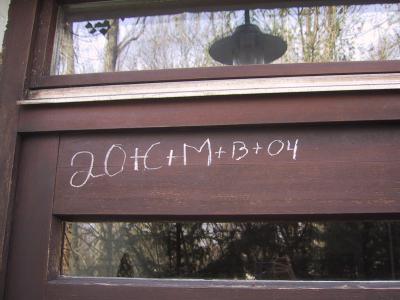
A few weeks into my stay, I noticed a peculiarity I had never noticed in any of my many travels across Europe; at every home I visited, the year and 3 letters were scrawled in chalk over the door – 19 + C + M + B + 94. When I asked about it, I was told in a matter-of-fact voice that Bavaria was still a very Catholic region and that every year on the Feast of the Epiphany, the family would say a prayer of blessing over their home.

I had grown up in a nominally Catholic home in Canada, and although my grandmother had been quite devout, I had never heard of a house being blessed, let alone an annual family prayer of blessing. It was already March, so when I asked for a bit more detail, the prayer had been forgotten, but I was told the letters stood for the 3 Magi: Caspar, Melchior and Balthazar, who sought Christ as we still seek Him.

Cool! I remember wanting to start this tradition when I got back home to Canada, but by the time the Feast of the Epiphany rolled around again, the idea had faded into the mists of the monastic beer gardens and everyday life.

Fast forward a few years and my wife and I moved into our first house. Our Catholic faith was a big part of our marriage, and had become a strong part of our new identity, so we asked our pastor to come and bless our new home. When I asked Father about chalking the door he responded with a puzzled look. There was no such thing as a smart phone back then, so there was no way of looking it up to show him. When we had our second home blessed, I had completely forgotten about the practice, and didn’t even ask.

Then last year, in the lull between Christmas festivities and back-to-school, the practice of Door Chalking showed up in my social media feed. I mentioned it to my wife, and she thought it would be a wonderful way to pray out the Christmas season. We used the short Carmelite prayer found here, and standing on a chair, I chalked our door for 2016.


Over the year the chalk has faded somewhat, but it is still there. This Sunday, on the Feast of the Epiphany, I’ll climb back up on a chair at the front door and lead our family in prayer. The chalked date and letters above the door reminding us each time we go out that we “Go forth to love and serve the Lord.”

Friday, December 14, 2012

Listening in Silence


Dear Theophilus,

The Advent season calls us to stop and take the time to reflect on the Saviour’s coming at Christmas. Finding a moment or two of silence in December to contemplate on this great mystery seems to be almost mission impossible. With the constant bombardment of holiday music (not always Christmas music) over store sound systems, the continual shill of television commercials telling us what we need to find under the tree on Christmas morning, along with the incessant chatter of children hyped up on Christmas treats and the promise of all their little dreams being fulfilled – it really is a wonder that we are able to keep our thoughts straight – let alone our sanity intact. On top of all the seasonal noise is the constant hum that the modern world gives us via our smart phones, iPods, the internet, cable TV, satellite radio … the list of distractions seems endless. But to truly appreciate the Advent season and our relationship with God, we need to seek out silence, because it is only in silence that we can truly listen to the word of God speaking in our hearts.

So often we say that we can’t hear God in our lives, but do we know where to listen for Him? Are we allowing God to speak to us in the way He wants to be heard? How do we know how God wants to speak to us? When we turn to the Bible, we can easily see that God speaks to us in the simplicity of silence.

When God spoke to Abram (and later as Abraham), calling him to leave his home for the Promised Land or to sacrifice his son, Abraham was usually alone or with only his son (cf.: Gen 12 and Gen 22). Whenever God wanted to speak with Moses, Moses would leave the Israelite camp to climb, alone and in silence, up Mount Sinai (cf.: Ex 19). When the Lord called to Samuel, he was lying quietly in the Temple (cf.:1 Sam 3).

The same kind of examples can also be found throughout the New Testament as well. When the angel of the Lord told Zechariah that Elizabeth was expecting a son, it was in the silence of the Holy of Holies, and when Zechariah wouldn’t believe the angel, he was struck mute until John the Baptist was born. (cf.: Lk 1:5-20). Whenever Jesus wanted to talk to his heavenly Father, he always sought him out in silence solitude, whether it was the 40 days in the desert to start his ministry (cf.: Mt 4); when the crowds followed him after his miracles, he would withdraw to deserted places to pray. (Lk 5:16); and on his final earthly evening, in the Garden of Gethsemane, Jesus left his disciples to go a few paces further to pray in silence. (cf.: Mt. 26:36-46, Lk 22:39-46). Even the final book of the Bible, the Revelation to St. John, was revealed when the evangelist found himself secluded on the Island of Patmos. (Rev 1:9)

How can we find silence amongst all of the distractions that our busy world throws at us? Silence isn’t to be found in today’s world, rather we need to create it. It should come as no coincidence then, that discipline and disciple are derived from the same root word. We need to discipline ourselves to be able to create more silence in our lives.

In his book Rediscover Catholicism, Matthew Kelly challenges us to spend at least 10 minutes a day in silent conversation with God. Ideally, he tells us, we should try to do this in a church – preferably our own parish. As churches are designed for contemplative prayer and Eucharistic adoration, they will provide the optimal surroundings for a silent 10 minutes with the Lord. Personally, I started following Kelly’s advice this week, spending 10 silent minutes in the school chapel before the start of the day. Although I find it hard to settle my mind, I find it reassuring to put my troubles before God, asking his guidance in how to best make my way through the coming day.

Matthew Kelly realizes that spending 10 minutes in a silent church every day isn’t always possible. We need to carve this silence out at other times and in other places. Some suggestions might be to try waking up 10 minutes earlier to sit quietly in your favourite chair, leaving your mp3 at home when you go for your daily run or take 10 minutes of silent contemplation at your desk before heading to the staff room for lunch.

Like I said, I’ve been finding it hard to get my mind to settle these first few days, but I’m also finding that my focus is getting better. It’s funny, but it’s the concerns that my mind wanders to that I find I need to place before the Lord, and by the end of the 10 minutes, I find I’ve got a plan on how to deal with them that not only solves my trivial problems, but also allows me to live God’s will. When you find you mind wandering, offer these distractions to God, allowing Him to guide your actions to do His will.

If you stick with it, I think that, like me, you will be pleasantly surprised to find how 10 minutes a day of listening to God in the silence, what H whispers to you can bring hours of peace to your life.

Tuesday, November 27, 2012

The Real Meaning of Advent


Dear Theophilus,

As Advent approaches Catholics the world over are called to make preparations for Christmas. Like the world over, those preparations usually involve making plans to travel, creating menus and shopping for grandiose meals, and, most importantly it seems, heading to the mall with lists if gifts for under the tree. With Christmas music playing over store sound system since mid-November, I’ll be Christmased out long before I make it to the vigil Mass on Christmas Eve.

Sometimes I find I need to take a moment away from the Christmas chaos to stop, pause and reflect on what Advent is all about to make sure I’ve got my priorities straight. I had one of those moments recently when I came across Jonathan McGovern’s blog, Scattered Thoughts of a Roam’in Catholic. In his post Where is the line??? he comments on the commercial pandemonium that is Black Friday and how North American society has strayed from the spiritual preparation that Advent is meant to be.

Like Jonathan’s blog did for me, we need to be reminded as a society as to Advent’s purpose. Yes, it is a time to prepare ourselves for Christmas, but this needs to be done in a spiritual way, not the materialistic, commercial way that some how takes over our lives come December. To be able to achieve this spiritual preparation, we need to remember what Christmas is all about – the birth of Jesus, the coming of Christ the Messiah, the Word becoming flesh and walking among us. If this is the case, shouldn’t the thought that occupies our minds during Advent be to ask ourselves why God sent his only Son to walk among His creation and not what to get the aunt we only see once a year.

To answer the question ‘Why did God become the Word incarnate?’ we need look no further than the first public announcement of Christ’s ministry on earth by his cousin, St. John the Baptist. Upon seeing Jesus for the first time the voice calling out in the wilderness pronounced:

Behold the Lamb of God who takes away the sin of the world! (Jn 1:29)

The Youcat expands on this by stating:

Why did God become man in Jesus?

In Jesus Christ, God reconciled the world to himself and redeemed mankind from the imprisonment of sin. “God so loved the world that he gave his only-begotten Son” (Jn 3:1`6). In Jesus, God took on our mortal human flesh, shared our earthly lot, our sufferings, and our death, and became one like us in all things but sin. (YC 76; ref. CCC 456-460)

Amidst all of the Christmas joy, this is a very sobering fact. The baby Jesus is born because we are sinners. The cute infant in the manger in Bethlehem has been conceived to die on Calvary for our sins. As sombre as it may seem, this is, however, something you can rejoice in – the forgiveness of sins is at hand through God’s saving grace.

As we go about the hustle and bustle of preparing materially for Christmas, we need to take the time to prepare spiritually for what it is meant to be. We need to take time out from preparing meals to prepare our hearts for God’s saving forgiveness become incarnate in the Christ child. We need to tune out the noise of the world around us and tune into the silence needed to examine our conscience to make sure we are ready to welcome Christ anew into the world.

And when we become despondent that we are alone in the world with our spiritual preparations, know that our gentle witness will send a ripple through society, calling all hearts to prepare for the coming of Christ.

Tuesday, June 26, 2012

Advent in June


Dear Theophilus,

The calendar intrigued me somewhat this past weekend. Here we are at the beginning of summer, yet in the Gospel we are reading what mounts to be Advent stories. Granted, these Advent stories of the birth of St. John the Baptist are read every year on his feast day, but with June 24th falling on a Sunday this year they were all the more evident.

Living in Canada, we seem to have lost sight of the meaning of this great fist in the liturgical calendar. We are more inclined to equate la Fête St. Jean Baptiste with the Fête nationale du Québec, a day for that province to express its cultural and linguistic identity. I don’t have a problem with Quebecers expressing their cultural heritage, in fact, it’s something I embrace, however, in the rest of Canada this can been seen in a negative light as this same expression has brought Quebec to the brink of separation from Canada on more than one occasion.

The funny thing is St. John the Baptist’s mission was one to prepare the Israelites for Christ’s unifying mission. Throughout his ministry, St. John the Baptist constantly pointed away from himself and towards Christ:

He must increase, but I must decrease. (Jn 3:30)

What do you suppose that I am? I am not he. No, but one is coming after me; I am not worthy to untie the thong of the sandals on his feet. (Acts 13:25)

I baptize you with water for repentance, but one who is more powerful than I is coming after me; I am not worthy to carry his sandals. He will baptize you with the Holy Spirit and with fire. (Mt 3:11)

It’s only fitting then that on the longest day of the year bonfires are lit in memory of St. John the Baptist. Beacons pointing towards Christ’s coming to purge the world of sin with the fire of his love through the Holy Spirit. At this time of year when Easter joy has become a faded memory and Christmas is too far away to really look forward to, it’s refreshing to recall that Christ’s unifying grace needs to be the focus of our life’s ministry, just as it was for John.

Thursday, December 22, 2011

Happy Hanukkah


Dear Theophilus,

I know it’s a couple of days late, but I wanted to wish you a Happy Hanukkah. Growing up, I had always thought that Hanukkah was the Jewish answer to Christmas, however, an article at American Catholic Blog (read it here) taught me that there is so much more to the Festival of Lights that is of importance to us as Catholics today.

Firstly, although as Catholics we are not called to celebrate Jewish feasts, we should get to know them if not simply for the reason that Christ was Jewish and these feasts would have played an important role in his own life. Since Jesus Christ is the fulfillment of scripture, understanding Jewish Festivals will help us understand our own Christianity. As St. Paul tells us in his letter to the Colossians:

Therefore do not let anyone condemn you in matters of food and drink or of observing festivals, new moons or Sabbaths. These are only a shadow of what is to come, but the substance belongs to Christ. (Col. 2:16-17)

The tradition of Hanukkah itself is instituted in scripture in the First Book of Maccabees when the Temple was cleansed and rededicated after the Maccabeen revolt:

Then they offered incense on the altar and lit the lamps on the lampstand and these gave light to the temple. So they celebrated the dedication of the altar for eight days, and joyfully offered burnt offerings; they offered a sacrifice of well-being and a thanksgiving offering. Then Judas and his brothers and all the assembly of Israel determined that every year at that season the days of dedication of the altar shall be observed with joy and gladness for eight days. (1 Macc. 4:50,56,59)

To understand the relevance of this Jewish festival for us as Catholics today, we need to understand the context of the temple rededication after the Maccabeen revolt. The Maccabees were a group of orthodox Jews who took on the Hellenised establishment. They wanted to see a return to spiritual tradition and a more pure form of Jewish practices to please Yahweh.

What does this mean to us? All we need to do is take a look around us this Advent season. As the coming of our Lord in Saviour in human form fast approaches, Christ’s birth is symbolized more by a man in dressed in red than a babe wrapped in swaddling clothes. Instead of bring gifts to the Christ Child, we spend endless hours making up wish-lists to give to others, ensuring our every desire is satisfied.

Although a Holocaust survivor recently ensured me that Hanukkah has become just as commercial as Christmas, we should take a lesson from the Maccabees, who foreshadowed the Light of Christ in rededicating the Temple (which Christ embodied himself), and return to a purer celebration of the spirit of Christmas.