Showing posts with label Sacred. Show all posts

Wednesday, September 21, 2016

In Defence of God's Holy Name


Dear Theophilous,

Waiting for a wayward student on the school bus a few years back, my colleague and I did a roll call to figure out who was missing. The bus was quiet, and about three-quarters of the way through the list there was no response to the name called. In the pregnant pause that followed, from somewhere in the back, came a loud, “Je*** Ch****! She’s always late.” To which I couldn’t help but immediately reply, “I’d rather you drop a holy f***, than what you just said if you’re going to swear at all!” Needless the dead silence that followed told me that I had gotten my point across.

You shall not invoke the name of the Lord, your God, in vain. Ex 20:7

Our Lord has a name that is so holy; it needs to be handled with caution. His name is so powerful, if not used properly; it can be dangerous for the one speaking it. The very mention of God’s name should give pause for reflection. The sound of the Lord’s name demands veneration. It is a name so sacred, He knows that we can’t even hear if from His own lips – when Moses asked God’s name in the burning bush, the answer was an enigmatic:

I am who I am. Ex 3:14

Some how, some where along the line, we seem to have lost this sense of the sacred. In western society in 2016, it’s not at all uncommon to hear a pejorative Je*** Ch****! or OM(F)G! at the drop of a hat, and nobody bats an eye.

Don’t get me wrong. There are still some circles where the name of God is still sacred; unmentionable. My experience is that this is among the more orthodox Jewish communities, many of who will still write G*d or Y*w*h to communicate His name without writing it. I think we have a thing or two to learn from this treatment of God’s name.

So how do we combat this de-sanctification of our Lord’s holy name? How do we change a world that seems bent on infuriating God? The same way it disintegrated… One soul at a time.

At the name of Jesus every knee should bend, of those in heaven and on earth and under the earth, and every tongue confess that Jesus Christ is Lord. Phil 2:10-11

“As I live, says the Lord, every knee shall bend before me, and every tongue shall give praise to God.” Rom 14:11

On thing that I’ve started doing, in the hopes of at least making people aware of their words, is to change these pejorative utterances of our Lord’s name into a prayer with a simple: Blessed be His name forever! and then bow my head.


I’m not sure how much of an effect this is having, but I’m sure it’s unnerving a few people. My next step – when I get up the courage, will to begin genuflecting at the sound of the Lord’s name. I can just imagine the fun some in my extended family will have with this – but hopefully my perseverance will eventually pay off.

Tuesday, February 2, 2016

From Cafeteria to Google Catholic


Dear Theophilous,

I think we’ve all heard of the term Cafeteria Catholic; referring to the kind of person who picks and chooses which Church teachings to follow and ignoring the ones they’d rather do without. The term comes from the same kind of whimsical approach most of us take when getting lunch at the cafeteria; perhaps choosing the daily special over the cellophane wrapped sandwich, or maybe this time we’ll take the red Jell-O instead of the green.

The sad thing is, we all probably know of at least one Cafeteria Catholic. There’s Uncle Fred who likes to take his Eucharist without the obligatory side of yearly confession. Or maybe there’s your pew neighbour who’s there every week, she coos at the babies being baptized and loves Pope Francis, but she also thinks a woman should have the right to choose abortion.

Unfortunately, when we try to show these folks that Catholicism is a smorgasbord rather than a cafeteria, where every last teaching is to be not only eaten, but also savoured, we’re usually shouted down for trying to force-feed them.

Recently, however, I’ve noticed an even more disturbing trend when it comes to Catholic teaching; something I would like to call Google Catholicism.

Let me explain…

My brother-in-law is in the last year of his radiology residency. Like all doctors, although his speciality is radiology, during his residency he has had to do stints in all areas of medicine from paediatrics to gerontology and everything in between. Early on in his residency he spent some time in the ER of a major downtown hospital. When I asked him about this experience, he said the worst part was that most patients that came in had already self-diagnosed from the internet, and that they were telling him the treatment he was supposed to prescribe. It seems that 30 seconds on Google supersedes 12+ years (at that particular moment) of university education.

A parallel can be extended to the Catholic Church. Pope Francis, himself, even likened “the Church as a field hospital after battle.”

From having watched and meditated upon the goings-on at the recent Synod on the Family; it’s left me wondering if the Church is a field hospital where the patients, and in some cases even the nurses, are telling the surgeons what treatments to prescribe. Those who were once Cafeteria Catholics, who picked and chose which teachings of the Church to follow to suit their needs, have now become Google Catholics, telling the Church which teachings to change to suit their needs.

The biggest hullabaloo seemed to centre on the question of Communion for divorced and re-married Catholics. Although there is a recognition of a state of sin (cf Mt 19:3-8; Mk 10:2-9 and Lk 16:18), the proponents of this practice, and others, seem intent on flying in the face of Christ’s teachings. The Magisterium is right in saying that there are simply some teachings that cannot be changed, because they come from Christ Himself; yet there are still some, both inside and outside the Church, who insist they know better.

On this matter, as well as any other (especially homosexuality), the pat argument of the Google Catholic is to trot out the ubiquitous Pope Francis quote: “Who am I to judge?” Although correct in that we do not have the right of final judgement on a person’s soul, we do have a responsibility to judge each other’s actions so as to best help one another present the best case possible when it comes to our final judgement. Added to this problem is the fact that this quote is usually wildly misused, misunderstood and presented out of context. Pope Francis himself recently explained: "On that occasion I said this: If a person is gay and seeks out the Lord and is willing, who am I to judge that person?" (cited in New Catholic Reporter) In this statement there is a notion of love for a sinner seeking mercy; a seeking out of the Lord and a willingness to follow in His ways of repentance.

Just as there is an inherent danger to our physical health when we self-diagnose and self-prescribe off the internet without the foundation of a sound medical education, so too is there an inherent danger to our spiritual health when we self-diagnose and self-prescribe for our sins. Being a Google Catholic can be great, if you allow it to open the doors to the smorgasbord of Catholic teaching. However, if you insist on being a Google Catholic to put yourself ahead of Christ and the 2000+ year cumulative teachings of the Church He founded – then you’re playing with fire.


Monday, December 7, 2015

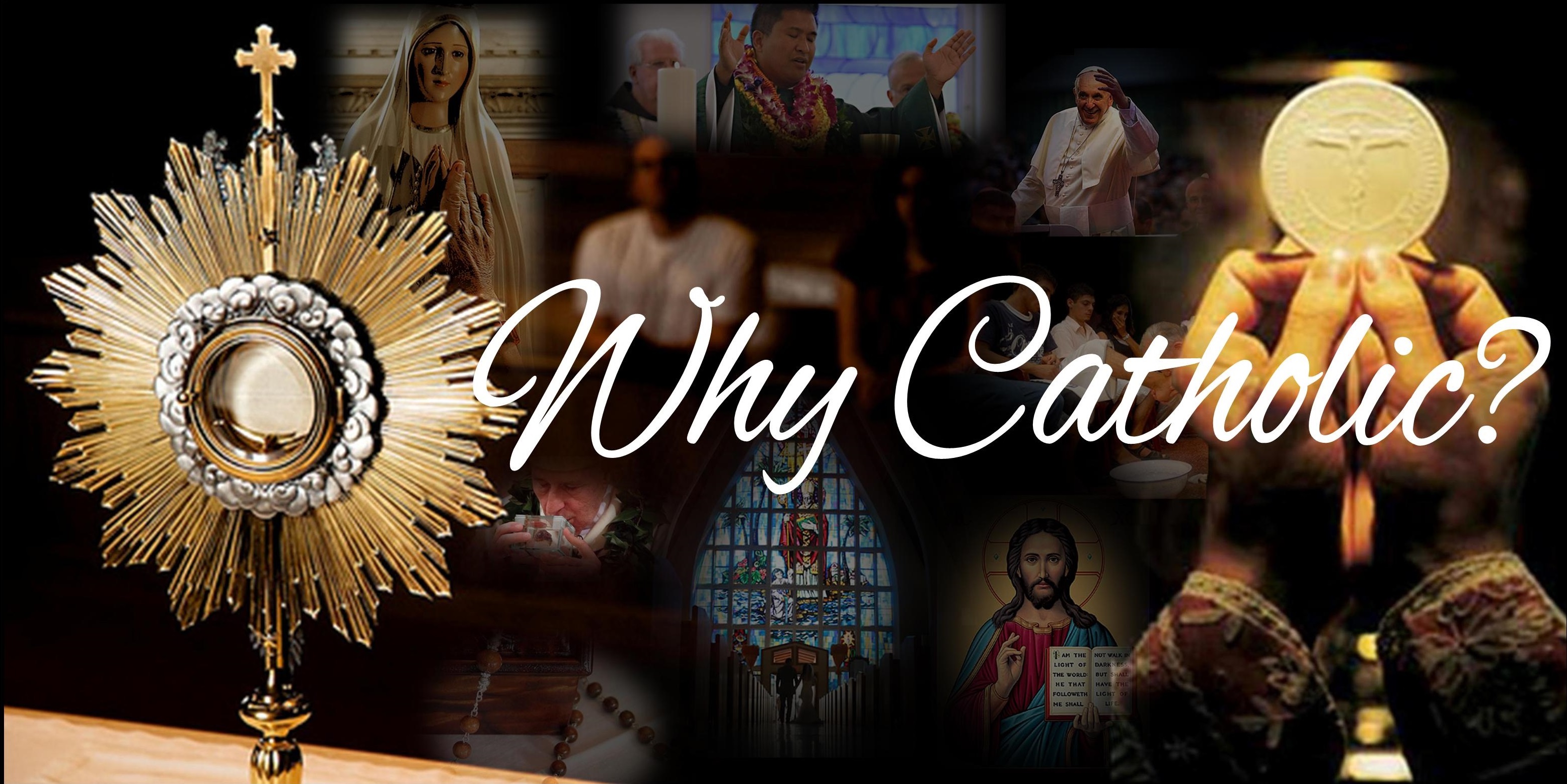
Why Be Catholic?


Dear Theophilous,

I’m what most people would consider a cradle Catholic, more or less. Shortly after I was born I was baptized at St. Anselm’s parish in Toronto. Even though it wasn’t their home parish, they had gotten married there, and thus the decision to have me baptized there. I don’t think any of us have ever been back to St. Anselm’s since.

I also have vague recollections of my sister’s baptism when I was 3, but most of my early childhood memories are of Sunday School at the local United Church. It wasn’t until I was 9 years-old and my mom went through the RCIA program that we started attending St. John Chrysostom and I made my first Reconciliation and Eucharist. From that point on, for all intents and purposes, was raised a cradle Catholic.

During those formative years, if you had asked me Why I was Catholic, I would have given the question about a 10-second thought before answering, “Because my parents are.” Actually, growing up in the Catholic school system, it just seemed natural that everybody and their parents (and their parents’ parents) were Catholic. It was just the natural order of things.

As I’ve been mellowing in my old age, however, I’ve been giving more and more thought to the question Why be Catholic? It’s a question I’ve heard discussed by a variety of different personalities on The Catholic Channel on SiriusXM, giving much food for thought. It’s a question I knew I had to answer once I saw it emblazoned on a banner in my mother-in-law’s parish in London, Ontario.

I know the answer, “Because my parents are,” will no longer hold water when it comes to defending my Catholic faith, so I narrowed it down to three key reasons:


  • The Eucharist
  • The Truth
  • My Family


The Eucharist

The Catechism of the Catholic Church rightly states that “The Eucharist is the source and summit of Christian life.” (CCC #1324) The Catechism tells us how all other sacraments, and all other life in the Church are bound up in the Eucharist and oriented toward it. How could they not be? This is the body and blood, soul and divinity of our Lord and Saviour. Really, the Eucharist is the be all and end all of what it means to be Catholic, and in my mind, what it means to be Christian.

Believing in the Eucharist isn’t easy. It never was. Even those who knew Christ and followed him daily had a hard time. During the Eucharistic Discourse in the Gospel according to St. John, when Jesus tells His followers they need to eat His flesh and drink His blood they grumble, “This is a hard saying; who can listen to it?” (Jn 6:60) And then when Jesus reiterated our need for the Eucharist, “many drew back and no longer walked with Him.” (Jn 6:66).

Knowing the Eucharist, understanding the Eucharist, loving the Eucharist; none of it is easy; but one you do, it is the most beautiful thing on Earth. I’ve heard it said that if we truly knew in our hearts what the Eucharist contained – wild horses could not keep us away from it. Some of the most profound moments in my life have come before the Blessed Sacrament, my heart physically pulled towards the Tabernacle; the ache of my suffering eased by the sacrifice on the altar; the tranquil warmth that fills me when I consume the Eucharist.

It is through the Eucharist that I love that I have come to know Christ’s love for me, a sinner.


The Truth

If the Eucharist is the source and summit of our faith, our faith hinges on a single question that Jesus asks us: “Who do you say that I am?” (Mk 8:29, Mt 16:15) How we answer that question changes everything. C.S. Lewis tells us we can answer this question in only in one of three ways: that Christ a liar, a lunatic, or He is Lord. Personally, I pick the third option each and every time.

Whenever defending doctrine or explaining a point of faith, I like to begin the discussion by asking this very question. The starting point with Christians is that He is Lord, God, one with the Father and the Holy Spirit. (If this isn’t the answer, there’s a whole other conversation that needs to take place). If Christ is God, then we have to take what He says as the Truth – like it or not.

Christ Himself tells us, “I am the way, the truth and the life.” (Jn 14:6) It’s not a boast – it’s a simple fact.

There are a lot of Christ’s teachings that are difficult, even more so now in the 21st Century than they were in the 1st Century (and look what they did to Jesus back then). When we propose that our truths are better than Christ’s, are we then not presupposing that we are greater than God?

The Truth that Christ gives us in His Gospel is like a beacon in the dark. The Truth guides us to the joy of eternal life in Him. The seas may be, and usually are, rough; but the guiding light of Christ’s love and Truth bring us to safety. Instead of binding us up, the Truth liberates us to not worry about the raging waters around us, but to take comfort in the safe harbour we are going to enter.


My Family

The joy of faith is not something to be kept in secret, a lamp hidden under a bushel basket; rather, it is to be shared freely. I love the expression: Don’t just keep the faith. Give it away!

I always teach my students that the true meaning of Love is “to want what is best for the other.” If I truly love my wife and if I truly love my son, how could I ever imagine to keep from them the beauty I have found in the Eucharist and the Truth? There is nothing I want more for them than the love of God.

This is how the faith has come down to us over 2,000 years. Passed from generation to generation, parent to child. I can’t think of any better gift I could give my son, a gift that will not only last a lifetime, but for all eternity.


Why Be Catholic? Is a question I had never given too much thought to, but it’s a question which defines who I am; who my family is.  This is a question I no longer run from, but embrace and am proud to answer.

Sunday, March 16, 2014

The Mind is Like an Umbrella ...


Dear Theophilus,

When I was in university I had a typical student car. It was a 10 year-old Volkswagen Rabbit diesel, a certain shade of mottled brown with a mustard interior. Unlike my present VW diesel, there was nothing turbocharged about the 4-speed manual transmission; indicated by the 1-2-3-E stamped on the gearshift – and according to my sister, the E didn’t stand for excellerate (sic).

What made this particular VW distinctly mine was the way I decorated the interior. I had the requisite national flag hanging from the rear-view mirror (I had just spent a year studying in Belgium); where the ceiling upholstery had fallen, I had stapled it back up in concentric circles; I also had a variety of toys and postcards glued to the dashboard.

Written on one of the postcards was the saying: The mind is like an umbrella, it works better when it is open.

I thought this was particularly clever, as did most of the people who sat in the passenger seat. The obvious purpose of an umbrella is to keep rain off of one’s head (something that had become quite evident during my time in Belgium), and the obvious way to do this efficiently is to open up the umbrella. The mind is the same: the purpose of the mind is to think, and the most efficient way to do this is to open one’s mind to new ideas, and then to think on them.

What was missing from the postcard cleverly glued to my dashboard was the notion that there are times when it’s better to have your umbrella closed. This is self-evident to anyone who has tried to walk their dog on a blustery day. Trying to balance the leash, a poop-bag and an umbrella torn by the unruly wind; something has got to give – and personally, I know it is better for me to come home a little damp and with the dog, than dry and without. 

There are other times, too, when the purpose of an open umbrella is quite counter-productive. Nothing lifts the spirits better on a cold drizzly day than to see the clouds part and the sun’s rays peek through. The immediate reaction when this happens is to close your umbrella and turn your face towards the sun, closing your eyes and basking in its glowing warmth. I don’t think it would take too much to convince you that in this particular instance, the umbrella works better when it’s closed.

While reading G.K. Chesterton’s Heretics, I was reminded recently that the mind, like an umbrella, can also work perfectly well when it’s closed; that it shouldn’t be left perpetually open. Although he doesn’t make the umbrella analogy, Chesterton wrote on the real purpose of having an open mind:

Merely having an open mind is nothing. The object of opening the mind, as of opening the mouth, is to shut it again on something solid.

I think Chesterton’s analogy is much more beautiful, and much more truthful, than that of the umbrella.

As a bit of a gourmand, I like to eat. Even more so when a meal is especially savoury. I try to use all of my senses in eating: allowing the scent to awaken my taste buds; devouring the plate set before me with my eyes; finally holding a morsel in my mouth, rolling it over with my tongue, not only tasting it, but savouring the texture as well. And like my mother always told me, I eat with my mouth closed.

So it should be when we open our mind to a new idea. We need to take it in, close our mind around it, and mull that new thought over. Like new foods, new thoughts can be delicious to our intellect. When that is the case, we want more and more of the same, closing our mind around something that is solid, something that is beautiful; the same way we would close our mouths around a dish we find pleasing to our palate.

Unfortunately, this closing of the mind on something solid, the savouring of an idea that is particularly pleasing to the spirit, is frowned upon in our modern western world. Whenever we try to stand for our principles, to express the beauty that is the Truth, we are told not to be close-minded, to open up to new ideas.

The problem is that it’s quite difficult to open the umbrella of the mind in today’s society. With the advent of the internet and the proliferation of self-expression in social media, the flow of ideas is much like that blustery day when I try to walk the dog with my umbrella. In fact, most days the torrent of ideas flashing around Twitter, Facebook and the blogosphere is more like a hurricane than a blustery spring shower. Ever tried opening an umbrella in a hurricane?

Then there are times when we find that ray of sunshine and the warmth that it brings. This is when the winds die down and the clouds part and God’s light illumines our world. When we find God’s Truth in Creation, we need to close our umbrella and bask in the warmth He brings to our souls.

Like Chesterton, who opens his mouth to close it on something solid and savoury, we need to open our minds to the Word of God, closing it on something that is more solid and delicious than any food found on earth.

Wednesday, January 15, 2014

Lectio Divina


Dear Theophilus,


Inspired by Archbishop Cardinal Collins, lately I have come into the practice of Lectio Divina as a part of my daily prayer life. This has grown out of a desire to read and meditate on the daily readings set out by the Church. 


An ancient tradition, dating back to Origen in the Third Century Lectio Devina can be simply translated as either Holy or Sacred Reading, referring to one reads and meditates on Sacred Scripture. This understanding of Lectio Devina is reiterated by Cardinal Collins in the introduction to his book Pathway to our Hearts, where he is quick to point out that Lectio Devina should not be approached as a course in Bible study (exegis). Although Cardinal Collins recognizes that Scripture study is important, he reminds us that Lectio Divina is meant to be a prayerful encounter with our living God through the inspired word of Sacred Scripture. 


There is no official format for Lectio Divina, however, there are certain elements that will help one get the most out of this spiritual practice. Reading, prayer, meditation and contemplation are all a part of Lectio Divina, however, the order you do these in depends on the amount of time you have to dedicate to Lectio Divina and finding a formula that works best for you. Since I can only dedicate 15 minutes to my daily Scripture reading (unlike the 45 minute Lectio Divina sessions Cardinal Collins offers monthly at St. Michael’s Cathedral in Toronto), I follow the simple formula of prayer, reading, and then combine my meditation and contemplation. 


I start with prayer to focus my mind and settle my heart. I find that this helps me ready myself to receive the Word of God and to meditate on how He is speaking to me. The prayer is usually quite simple, I either allow the Holy Spirit to guide my prayer: Lord, please allow me to hear your will for me today in your word; or I will recite the words of the prophet Samuel: Speak Lord, your servant is listening. If I am feeling particularly agitated, I may even recite a decade of the Rosary. 


My heart and mind ready to listen to the Lord, I turn to the passage I have chosen to read that day. I usually read the Bible readings for the day, but there are other times when I feel I need to return to Sunday’s Gospel throughout the rest of the week; and still other times there is a particular passage that I feel is pertinent to my life right now. Since Lectio Divina is meant to be a prayerful encounter with God through Scripture I read the passage slowly and out loud, imagining that I am proclaiming the Word at Mass. I let the Word linger on my lips, savouring what God is saying. Searching for what God is trying to tell me. 


This is where meditation and contemplation on the Word comes in. I will often read, re-read and read the passage again. There will be key phrases and words that jump off the page for me. There are times when I have returned to a reading and God has prompted my attention in a new direction, peeling back the layers of his will for me. Usually I am surprised by how there is something in the reading that speaks directly to something going on in my life. I have even laughed out loud when the Lord has offered me a solution to a problem that I had not thought of, but with His help seems so obvious. 

I will then finish my meditation with an Our Father, Hail Mary and Glory Be.


My Lectio Divina complete, I find renewed strength to take on the day. I take courage in knowing that God has a plan for me, and that I am setting out to do His will.


Friday, January 10, 2014

Every Mass is like High Mass


Dear Theophilus,

As a family we like to start school breaks (Christmas and summer) with a little get-a-way. We find our holidays to be more relaxing because there is a distinct break between work and down time with the forced relaxation that a hotel stay brings. It’s nothing extravagant, just a couple of nights in a hotel with a pool in downtown Toronto, with someone to make the beds, cook meals and do the dishes for few days.

Each year one of the highlights is attending High Mass at St. Michael’s Cathedral.

One of the reason’s my son likes going to the cathedral because his name is also Michael, so he feels a certain link with the church, like it’s his very own. He also likes looking for the Archbishop’s tasselled hat hanging above the altar. And the look of awe in his eye when he saw Thomas Cardinal Collins processing in was only matched by his excitement when he realized we would received communion from his Eminence.

Personally, I find a certain enchantment with the sacred beauty that Mass at the cathedral entails. There is all of the sacred art – murals, stained glass, the gold gilded tabernacle; which all focus the mind towards God (unfortunately all hidden behind restorers’ scaffolding on our December visit). When the 100-voice strong choir from the acclaimed St. Michael’s Boys’ Choir School sang the Gloria, I closed my eyes and imagined that this must be as close as earthly possible to the Angels’ refrain on the night of the Nativity. Added to this was the sweet scent of incense, and I felt that I was participating in something sacred.

I was so moved and excited by the whole experience, shortly after Mass I sent a text message to a friend: High Mass at the Cathedral with the Cardinal. AWESOME!!!!!!

To which he replied: Very cool … our Mass parish priest … no power … still awesome …


I was dumbfounded. He was so very right! Yes, all the sacred beauty and enchantment of the cathedral Mass are wonderful, but what is truly awesome, the source and summit of our faith, is the Eucharist. Whether it is celebrated on the altar of the humblest of chapels or under the Dome of St. Peter’s in Rome, the core of the Mass is the same. We are called to partake in Christ’s sacrifice in the Eucharist. AWESOME!!!!!