Showing posts with label Truth. Show all posts

Monday, December 7, 2015

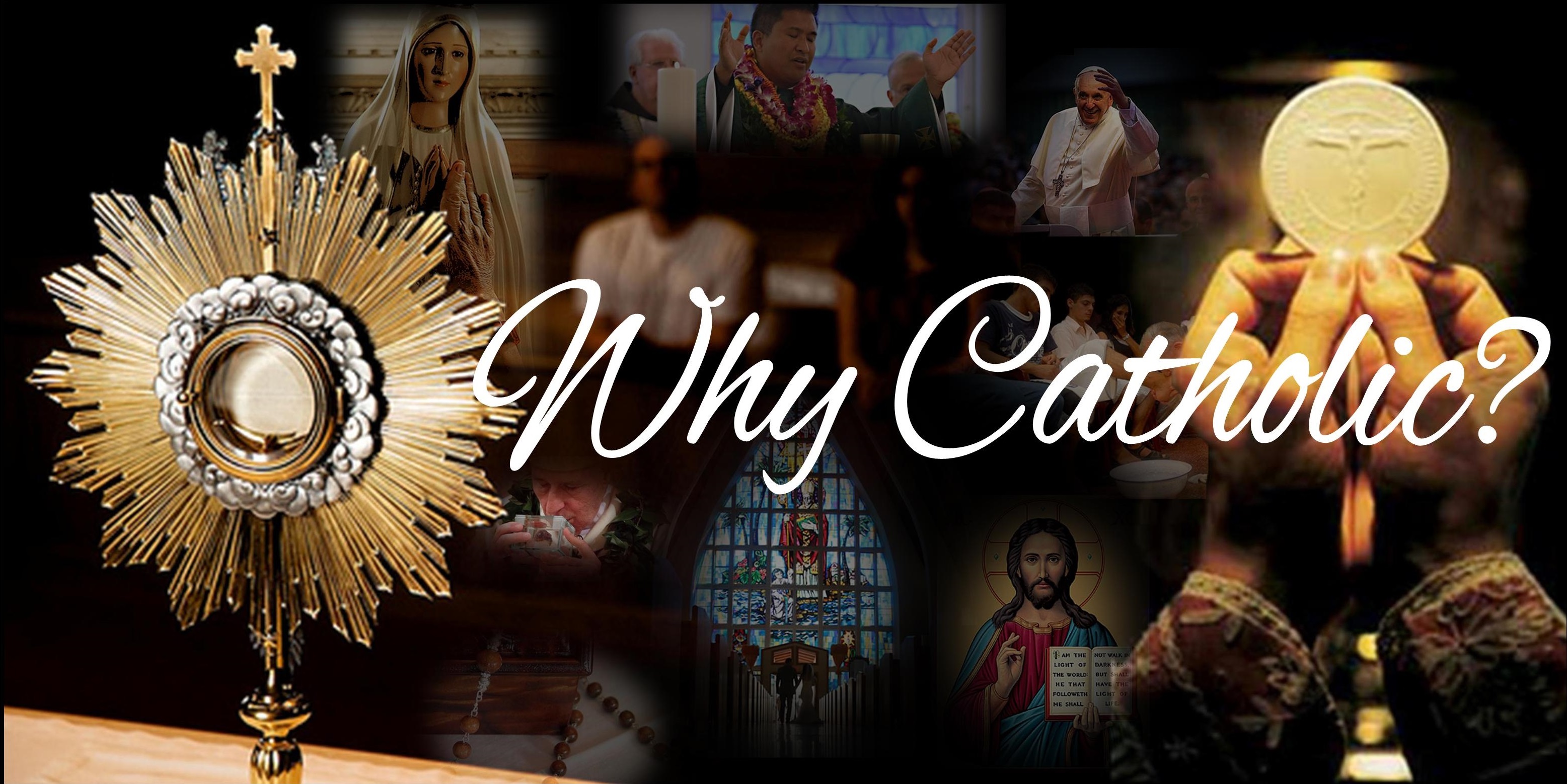
Why Be Catholic?


Dear Theophilous,

I’m what most people would consider a cradle Catholic, more or less. Shortly after I was born I was baptized at St. Anselm’s parish in Toronto. Even though it wasn’t their home parish, they had gotten married there, and thus the decision to have me baptized there. I don’t think any of us have ever been back to St. Anselm’s since.

I also have vague recollections of my sister’s baptism when I was 3, but most of my early childhood memories are of Sunday School at the local United Church. It wasn’t until I was 9 years-old and my mom went through the RCIA program that we started attending St. John Chrysostom and I made my first Reconciliation and Eucharist. From that point on, for all intents and purposes, was raised a cradle Catholic.

During those formative years, if you had asked me Why I was Catholic, I would have given the question about a 10-second thought before answering, “Because my parents are.” Actually, growing up in the Catholic school system, it just seemed natural that everybody and their parents (and their parents’ parents) were Catholic. It was just the natural order of things.

As I’ve been mellowing in my old age, however, I’ve been giving more and more thought to the question Why be Catholic? It’s a question I’ve heard discussed by a variety of different personalities on The Catholic Channel on SiriusXM, giving much food for thought. It’s a question I knew I had to answer once I saw it emblazoned on a banner in my mother-in-law’s parish in London, Ontario.

I know the answer, “Because my parents are,” will no longer hold water when it comes to defending my Catholic faith, so I narrowed it down to three key reasons:


  • The Eucharist
  • The Truth
  • My Family


The Eucharist

The Catechism of the Catholic Church rightly states that “The Eucharist is the source and summit of Christian life.” (CCC #1324) The Catechism tells us how all other sacraments, and all other life in the Church are bound up in the Eucharist and oriented toward it. How could they not be? This is the body and blood, soul and divinity of our Lord and Saviour. Really, the Eucharist is the be all and end all of what it means to be Catholic, and in my mind, what it means to be Christian.

Believing in the Eucharist isn’t easy. It never was. Even those who knew Christ and followed him daily had a hard time. During the Eucharistic Discourse in the Gospel according to St. John, when Jesus tells His followers they need to eat His flesh and drink His blood they grumble, “This is a hard saying; who can listen to it?” (Jn 6:60) And then when Jesus reiterated our need for the Eucharist, “many drew back and no longer walked with Him.” (Jn 6:66).

Knowing the Eucharist, understanding the Eucharist, loving the Eucharist; none of it is easy; but one you do, it is the most beautiful thing on Earth. I’ve heard it said that if we truly knew in our hearts what the Eucharist contained – wild horses could not keep us away from it. Some of the most profound moments in my life have come before the Blessed Sacrament, my heart physically pulled towards the Tabernacle; the ache of my suffering eased by the sacrifice on the altar; the tranquil warmth that fills me when I consume the Eucharist.

It is through the Eucharist that I love that I have come to know Christ’s love for me, a sinner.


The Truth

If the Eucharist is the source and summit of our faith, our faith hinges on a single question that Jesus asks us: “Who do you say that I am?” (Mk 8:29, Mt 16:15) How we answer that question changes everything. C.S. Lewis tells us we can answer this question in only in one of three ways: that Christ a liar, a lunatic, or He is Lord. Personally, I pick the third option each and every time.

Whenever defending doctrine or explaining a point of faith, I like to begin the discussion by asking this very question. The starting point with Christians is that He is Lord, God, one with the Father and the Holy Spirit. (If this isn’t the answer, there’s a whole other conversation that needs to take place). If Christ is God, then we have to take what He says as the Truth – like it or not.

Christ Himself tells us, “I am the way, the truth and the life.” (Jn 14:6) It’s not a boast – it’s a simple fact.

There are a lot of Christ’s teachings that are difficult, even more so now in the 21st Century than they were in the 1st Century (and look what they did to Jesus back then). When we propose that our truths are better than Christ’s, are we then not presupposing that we are greater than God?

The Truth that Christ gives us in His Gospel is like a beacon in the dark. The Truth guides us to the joy of eternal life in Him. The seas may be, and usually are, rough; but the guiding light of Christ’s love and Truth bring us to safety. Instead of binding us up, the Truth liberates us to not worry about the raging waters around us, but to take comfort in the safe harbour we are going to enter.


My Family

The joy of faith is not something to be kept in secret, a lamp hidden under a bushel basket; rather, it is to be shared freely. I love the expression: Don’t just keep the faith. Give it away!

I always teach my students that the true meaning of Love is “to want what is best for the other.” If I truly love my wife and if I truly love my son, how could I ever imagine to keep from them the beauty I have found in the Eucharist and the Truth? There is nothing I want more for them than the love of God.

This is how the faith has come down to us over 2,000 years. Passed from generation to generation, parent to child. I can’t think of any better gift I could give my son, a gift that will not only last a lifetime, but for all eternity.


Why Be Catholic? Is a question I had never given too much thought to, but it’s a question which defines who I am; who my family is.  This is a question I no longer run from, but embrace and am proud to answer.

Tuesday, September 29, 2015

Crying the Confiteor


Dear Theophilous,

I’ve always been a little bit on the sappy side. Ever since I was a kid, it hasn’t taken a whole lot to get me to tear up. At a very young age I learned why they called them tearjerker movies, but I never could really understand why there were tearjerker commercials on TV. Even today, if there is the least bit of emotional sentiment being expressed, I find my eyes begin to well up and I need to choke back the tears.

As I’ve gotten older, I have become better at keeping my emotions in check as my surroundings dictate. I really need to be caught off guard by a film I’m showing in class for the tears to come (can’t be letting the kids see me cry). If I do feel the tears starting to come, usually the classroom is dark enough for me to get to the door and step out into the hallway until I can get things back under control.

In other words – I don’t cry in public…

…until one day this past summer.

During the summer holidays I like to get to daily Mass at least once a week. The day of the week changes based on what we’ve got going on, or if I can get myself out of bed in time; but I do make the effort to get there at least one day through the week. I like the simplicity of the daily Mass, and I like the quiet. I especially like the quiet (in particular those moments of silence when music fills the void on Sundays – not that I mind the music, it’s just sometimes silence is nice too).

At this one particular daily Mass in the middle of August, as the 2 dozen or so of us in the congregation were saying the Confiteor the tears started coming, and there was no way I could stop them.

The long and the short of the whole story – I realized what I was saying, and I realized how unworthy I am of God’s mercy.

Although it has taken me a while to get up the courage to share this with you, dear Theophilous, I would like to share the Confiteor with you, and then take you through the thoughts that stirred so much emotion.

I confess to Almighty God,
and to you, my brothers and sisters,
that I have greatly sinned,
in my thoughts and in my words,
in what I have done and in what I have failed to do,
through my fault, through my fault,
through my most grievous fault;
therefore I ask the blessed Mary ever-Virgin,
all the Angels and Saints,
and you, my brothers and sisters,
to pray for me to the Lord our God.
Amen.


So now bit by bit, couplet by couplet, my reflections on the Confiteor…

I confess to Almighty God,
and to you, my brothers and sisters,

Confession is nothing new. My family and I try to make a regular habit of it (though it is admittedly more irregular than regular). I had been away from the sacrament for some time, and found it difficult at first, but now I find I get antsy if we haven’t been in a while.

On this particular day, at this particular Mass, with these particular words, I began to realize just how personal my confession is. It’s not just some list to be rattled off by rote, or a pat “The usual” or “The same as last time”. This time I was acutely aware of the reality of my sins and that they hurt my relationship with God. I also became more conscious of the fact that the Father already knows my sins, and that I He would be more merciful if I came clean and repented myself.

This time I was also struck that I was confessing to the whole congregation – my brothers and sisters. Not only did my sins affect my relationship with God, but with the entire Body of Christ – the Church. It felt weird at first to be confessing to others in the congregation, but then I was comforted by the words of St. James’ letter: Therefore confess your sins to one another, and pray for one another, that you may be healed. (James 5:16) It brought me solace to know that no matter how great of a sinner any of us are, we’re in this together. That we are the Body of Christ, and that when one part of the body is ill, the rest of the body pulls together to heal itself.


that I have greatly sinned,
in my thoughts and in my words,
in what I have done and in what I have failed to do,

Even on the days when I’m just rattling through the Confiteor, these lines act like a mini examination of conscience for me. My mind starts racing and I can never seem to get through the list before we’ve moved on to the next couplet.

This, however, was really the moment when I realized the seriousness of what I was saying. The moment when the tears started coming.

This time I stopped, though. I slowed down and listened to what I was saying… I have greatly sinned. There should be no trivializing of my sin. No rushing through the list to make sure I didn’t miss anything. If my sins are great enough to list, then they are great enough to have offended God. Although there is a difference between venial and mortal sin, all sin offends God. All sin drives a wedge between ourselves and the Father who loves us. All sin is great in its harm.

So then I dug deep. I recalled not only my sins of action, but also the thoughts that had germinated those sins. I also recalled the thoughts that started me on the road toward sin, but through the grace of God I was able to catch before they came to fruition; thoughts that are still sin as Christ taught us. (cf Mt 5:28)

And then there is the kicker: in what I have done and in what I have failed to do. Not only to I need to recall all of my sins, but I also need to remember when I should have done something but I didn’t. How many times had I passed the homeless on the street, turned a blind eye to someone who needed help, shirked away instead of defending the Church.

I have sinned… lots… and I have sinned greatly… and I just at that moment realized what that meant to my relationship with God and others.

And matters were only getting worse (and the tears copious) as I knew that this sinning was…

through my fault, through my fault,
through my most grievous fault;

I had nowhere to hide; no one to blame it all on. These sins are mine and mine alone. I knew what I was doing (but maybe pretended I didn’t). I had made the conscious decision. It’s always a humbling experience to admit it… but these sins were my own fault and nobody else’s.

I wanted to do more than pound my chest. I wanted to wail and rend my garments. I was devastated. My sins felt greater than me, that I could not overcome them to receive God’s mercy.

Thank goodness we have friends greater than this world to help us through…

therefore I ask the blessed Mary ever-Virgin,
all the Angels and Saints,

A sense of calm began to wash over me. I could ask for help. All those who are close to the Lord would pray for me: Mary, His Mother; the Angels who surround, serve and worship the Lord; and the Saints, those humans who would tell you that they were the greatest sinners. They would all be praying for me, as well as for you.

With the list of sins that had just flashed through my mind, I needed all the help I could get; and the closer the help was to God, the better.

and you, my brothers and sisters,
to pray for me to the Lord our God.

And yes, I knew I had to pray for all of my brothers and sisters in Christ, because I sure knew that I needed their prayers. Just like St. James exhorted us to do, we needed to pray for one another for healing. The journey through life is too arduous to do it alone, we need one another’s help. When one of us falls, the others need to pick them up through prayer and spiritual guidance.

Reinforced with the knowledge that I had all of that prayer behind me, the tears subsided and the sniffling stopped. As we moved into the liturgy of the word, my mind and heart felt like fertile ground for the seed of God’s wisdom. And the Eucharist, my heart itself was moved to a warmth that spread through my whole body.

Although I’ve never said the Confiteor by rote since; always aware of what I’m saying, aware of the damage my sins have done; I’ve never been so acutely aware of my sins and God’s bountiful mercy for those who seek it, as I was on that August morning in a quiet suburban church.

Tuesday, September 1, 2015

The Gate is Narrow and the Way is Hard


Dear Theophilous,

Every week when the local paper shows up at the door, one of the first things I do is flip to the back and scan the obituaries. Whenever I get caught doing this I’ll glibly reply that I was just making sure my name wasn’t there and I can continue breathing.

Joking aside, I have noticed an interesting trend from obituary writers, most of who use opening lines such as:

… has gone to reside in the Lord.

… has become another angel in heaven.

…has joined mom/dad in heaven.

Reading the obits these days, it seems as though everyone gets into heaven and no one is going to hell. Don’t get me wrong, I am not saying that we all don’t go to the Lord, we do since He is our final judge, but it seems that we think we have already figured out what His verdict of our loved ones will be.

This is our calling, and this is our hope; that we will be reunited with our Lord in paradise. This is something I pray for everyday; for myself, for my family, for my friends and for those who have no one to pray for them.

Yet, in a world that’s rife with evil, we need to acknowledge the existence of hell. We need to recognize that not everyone accepts the will of God. We need to understand the truth behind one of Christ’s most difficult teachings; a lesson I’m certain it pained him to share:

Enter by the narrow gate; for the gate is wide and the way easy, that leads to destruction, and those who enter by it are many. For the gate is narrow and the way is hard, that leads to life, and those who find it are few. (Mt 7:13-14)

This teaching of Christ struck me recently while I was reflecting on my misspent youth, and I realized the irony of the titles of two of my favourite songs from my teenage years: Highway to Hell and Stairway to Heaven. It seems these two rock bands understood Christ’s teaching on traffic flow. Even within the songs’ lyrics we can see hints as to cosmic battle for souls:

No stop signs
Speed limit
Nobody's gonna slow me down
Like a wheel
Gonna spin it
Nobody's gonna mess me around
Hey, Satan
Payin' my dues
Playin' in a rockin' band
Hey, mamma
Look at me
I'm on the way to the promised land

I'm on the highway to hell
Highway to hell

(excerpt – Highway to Hell – AC/DC – 1979)


To which the answer would be:

If there's a bustle in your hedgerow, don't be alarmed now,
It's just a spring clean for the May queen.
Yes, there are two paths you can go by, but in the long run
There's still time to change the road you're on.

(excerpt – Stairway to Heaven – Led Zeppelin – 1971)


Intentional or not, these songs fit so nicely into Jesus’ teaching on salvation.

The pathway to destruction is wide and easy, very much like a highway. Although it may not be the Autobahn without a speed limit, once we get rolling along that highway to perdition it becomes very hard to slow down, change lanes and take the off ramp. And Satan makes no bones about it, even though he promises you greatness and pleasure in this life, he promises neither joy nor comfort in the life to come.

The pathway to life is hard, just like spring cleaning or climbing a stairway that seems to go on forever (or an eternity). However, be not afraid, don’t be alarmed, because the May queen, Mary, is here to help. Christ’s mother draws us closer to Him with a simple phrase: Do whatever He tells you. (Jn 2:5)

There’s till time, dear Theophilous, for both of us, as well as the whole world, to change the road we are on; to find the narrow gate; to take the way that is hard; and to climb the Stairway to Heaven.

Sunday, March 16, 2014

The Mind is Like an Umbrella ...


Dear Theophilus,

When I was in university I had a typical student car. It was a 10 year-old Volkswagen Rabbit diesel, a certain shade of mottled brown with a mustard interior. Unlike my present VW diesel, there was nothing turbocharged about the 4-speed manual transmission; indicated by the 1-2-3-E stamped on the gearshift – and according to my sister, the E didn’t stand for excellerate (sic).

What made this particular VW distinctly mine was the way I decorated the interior. I had the requisite national flag hanging from the rear-view mirror (I had just spent a year studying in Belgium); where the ceiling upholstery had fallen, I had stapled it back up in concentric circles; I also had a variety of toys and postcards glued to the dashboard.

Written on one of the postcards was the saying: The mind is like an umbrella, it works better when it is open.

I thought this was particularly clever, as did most of the people who sat in the passenger seat. The obvious purpose of an umbrella is to keep rain off of one’s head (something that had become quite evident during my time in Belgium), and the obvious way to do this efficiently is to open up the umbrella. The mind is the same: the purpose of the mind is to think, and the most efficient way to do this is to open one’s mind to new ideas, and then to think on them.

What was missing from the postcard cleverly glued to my dashboard was the notion that there are times when it’s better to have your umbrella closed. This is self-evident to anyone who has tried to walk their dog on a blustery day. Trying to balance the leash, a poop-bag and an umbrella torn by the unruly wind; something has got to give – and personally, I know it is better for me to come home a little damp and with the dog, than dry and without. 

There are other times, too, when the purpose of an open umbrella is quite counter-productive. Nothing lifts the spirits better on a cold drizzly day than to see the clouds part and the sun’s rays peek through. The immediate reaction when this happens is to close your umbrella and turn your face towards the sun, closing your eyes and basking in its glowing warmth. I don’t think it would take too much to convince you that in this particular instance, the umbrella works better when it’s closed.

While reading G.K. Chesterton’s Heretics, I was reminded recently that the mind, like an umbrella, can also work perfectly well when it’s closed; that it shouldn’t be left perpetually open. Although he doesn’t make the umbrella analogy, Chesterton wrote on the real purpose of having an open mind:

Merely having an open mind is nothing. The object of opening the mind, as of opening the mouth, is to shut it again on something solid.

I think Chesterton’s analogy is much more beautiful, and much more truthful, than that of the umbrella.

As a bit of a gourmand, I like to eat. Even more so when a meal is especially savoury. I try to use all of my senses in eating: allowing the scent to awaken my taste buds; devouring the plate set before me with my eyes; finally holding a morsel in my mouth, rolling it over with my tongue, not only tasting it, but savouring the texture as well. And like my mother always told me, I eat with my mouth closed.

So it should be when we open our mind to a new idea. We need to take it in, close our mind around it, and mull that new thought over. Like new foods, new thoughts can be delicious to our intellect. When that is the case, we want more and more of the same, closing our mind around something that is solid, something that is beautiful; the same way we would close our mouths around a dish we find pleasing to our palate.

Unfortunately, this closing of the mind on something solid, the savouring of an idea that is particularly pleasing to the spirit, is frowned upon in our modern western world. Whenever we try to stand for our principles, to express the beauty that is the Truth, we are told not to be close-minded, to open up to new ideas.

The problem is that it’s quite difficult to open the umbrella of the mind in today’s society. With the advent of the internet and the proliferation of self-expression in social media, the flow of ideas is much like that blustery day when I try to walk the dog with my umbrella. In fact, most days the torrent of ideas flashing around Twitter, Facebook and the blogosphere is more like a hurricane than a blustery spring shower. Ever tried opening an umbrella in a hurricane?

Then there are times when we find that ray of sunshine and the warmth that it brings. This is when the winds die down and the clouds part and God’s light illumines our world. When we find God’s Truth in Creation, we need to close our umbrella and bask in the warmth He brings to our souls.

Like Chesterton, who opens his mouth to close it on something solid and savoury, we need to open our minds to the Word of God, closing it on something that is more solid and delicious than any food found on earth.

Thursday, January 30, 2014

What Would Jesus Do?


Dear Theophilus,

WWJD? What Would Jesus Do? The question is just about as ubiquitous as the colourful plastic bracelets. Unfortunately, I don’t think the majority of the people asking the question would be happy with the answer.

The question, WWJD? is usually followed by the questioner citing Christ: You shall love your neighbour as yourself, (Mt 22:39) or Just as I have loved you, you also should love one another. (Jn 13:34) The intended meaning being that if you are a true Christian, then you will let others do whatever they please, not hold them up to a moral standard; that love must somehow equal permission.

This endemic problem stems from contemporary society’s habit to read their own perspective and opinion onto the sayings of Christ instead of reading what Christ has to say onto their perspective and opinion. As Michael Coren so aptly put it in his book Heresy, people are looking for God the Grandfather (doting and obliging) instead of God the Father (wise and guiding, yet firm with His love). We seem to have forgotten that sometimes love has to say, “No.”

The people who trot out the question, What Would Jesus Do? enrobing themselves in what they perceive to be the love of Christ, a love which will let them do their own will instead of God’s, are usually surprised by Jesus’ stronger words of love and what one should do:

Do not think that I have come to abolish the law or the prophets; I have come not to abolish but to fulfill. For truly I tell you, until heaven and earth pass away, not one letter, not one stroke of a letter, will pass from the law until all is accomplished. Therefore, whoever breaks one of the least of these commandments, and teaches others to do the same, will be called the least in the kingdom of heaven; but whoever does them and teaches them will be called great in the kingdom of heaven. (Mt 5:17-19)

Guiding us to follow the Commandments God set out in His covenant with His people. That by following His law we will come to know greatness in heaven.

Christ also stated:

I came to bring fire to the earth, and how I wish it were already kindled! I have a baptism with which to be baptized, and what stress I am under until it is completed! Do you think that I have come to bring peace to the earth? No, I tell you, but rather division. (Lk 12:49-51)

The fire Christ promises is to purge us from our sinful ways. The division He brings is between those who choose to follow Him and those who reject His law.

I know that much of what I have just written would come across as being hardhearted. That, according to what many people in the world say today, I am being un-Christian. The crux of my point here returns to what I have already said, when we quote Christ saying Love your neighbour as yourself ; are we reading our own perspective onto Christ’s words, or are we reading His words onto our perspective? Do we really understand the true meaning of God’s love?

Christ’s love for us desires to bring us to an eternal wholeness, and this is a love He calls us to share with one another. Christ’s love strives to bring us out of our sinfulness and into the light of His ways, and this is the love that He calls us to share with one another. Christ’s love accepts us for who we are, yet challenges us to change for the better, to go and sin no more; and this is the love He calls us to share with one another.

In this light when we are faced with a moral dilemma, What Would Jesus Do? is a legitimate question to ask ourselves, and others. The question calls us to a higher moral standard; a divine moral standard at that. WWJD? demands that we mirror Christ’s love by keeping others from harm, calling them from their sinful ways. Perhaps the hardest thing of all for us to do when we strive to Do what Jesus did; is to judge sinful actions without being judgemental of the sinner.

The next time someone trying to argue for permission for their sinful ways tries to take the ethical upper hand by asking WWJD? followed by the usual Jesus quote: Just as I have loved you, you also should love one another; I will answer them as Jesus did: You are wrong because you know neither the scriptures nor the power of God. (Mt 22:29)
 

Monday, July 8, 2013

Keeping the Commandments in Order


Dear Theophilus, 

The more I read and the more I sit back and watch the world go by, the more I come to realize that we’ve got our priorities backwards. By we I mean a generalization of those of us blessed enough to live in western society (Europe and North America); and by priorities I am referring to our Christian commandments. 

I know it’s never a wise thing to make sweeping generalizations, especially of such a large population base. There will always be exceptions to the rule. I also acknowledge the large gamut of experiences, opinions and actions of such a large group of people makes it impossible to shade them all with one colour, particularly when you get out to the fringes. Still, I think a little bit of self-reflection (myself included) would help bring things into greater focus when it comes to following the commandments in their proper order. 

When we think of God’s commandments, our minds usually jump to the image of Charleton Heston holding two stone tablets etched by the finger of God. As well, most of us can also recite from memory (in some form or another) the list from Exodus 20:1-17 

1.      You shall have no other gods before Me.
2.      You shall not worship idols.
3.      You shall not use the Lord’s name in vain.
4.      Keep the Sabbath holy.
5.      Honour your father and mother.
6.      You shall not murder.
7.      You shall not commit adultery.
8.      You shall not steal.
9.      You shall not bear false witness.
10.  You shall not covet your neighbour’s wife or goods.

As Christians, however, when we think of the commandments, we need to think of the commandments that Christ gave us. And for those who are like myself and have troubles with memorizing such a long list as was given to Moses, we’re all pretty happy that Jesus was able to summarize the Ten Commandments quite nicely in just two: 

You shall love the Lord your God with all your heart, and with all your soul and with all your mind. This is the greatest and first commandment. And the second is like it: you shall love your neighbour as yourself. On these two commandments hang all the law and the prophets. (Mt 22:37-40) 

Here is where my generalizing of western society starts to kick in. 

It’s been my experience that when we look at the Old Testament commandments, we have numbers 5 to 10 down pat; and when we come to the New Testament commandments, we seem to skip over the first and overuse the second. We seem to have forgotten numbers 1 to 4, or, according to Christ, the greatest commandment: You shall love the Lord your God. 

Love your neighbour as yourself or Treat others as you would want to be treated. It’s a common refrain that helps keep us from falling into complete anarchy. As a parent I try to drill this into my son’s psyche. As a teacher, I try to guide my students to live by this principle. As a society we use this mantra to keep everyone on the right track. But without the first commandment, it’s an empty philosophy without foundation. 

Don’t get me wrong, a lot of good gets done in the world because of this commandment. As Christian’s, however, we need to follow this second commandment out of commitment to the first. As numerous Catholic authors (such as Matthew Kelly, Peter Kreeft and George Weigel) have pointed out: if we love our neighbour without loving God first, then we become nothing more than an NGO, a charitable organization, or a branch of the government dedicated to helping others. 

As Christians, it’s only logical that Christ’s first commandment will flow into the second. If we truly love God, then of course we will love our neighbour whom He made in His own image.

The challenge is this, dear Theophilus, not to simply do good because it is good (most of us do this already), but to find ways of deepening our love for the Lord so that goodness can flow from that love. By right-ordering God’s commandments, by putting God first, our strength and commitment to do good as a witness to God in the world will grow exponentially.