Showing posts with label signs of faith. Show all posts

Monday, December 7, 2015

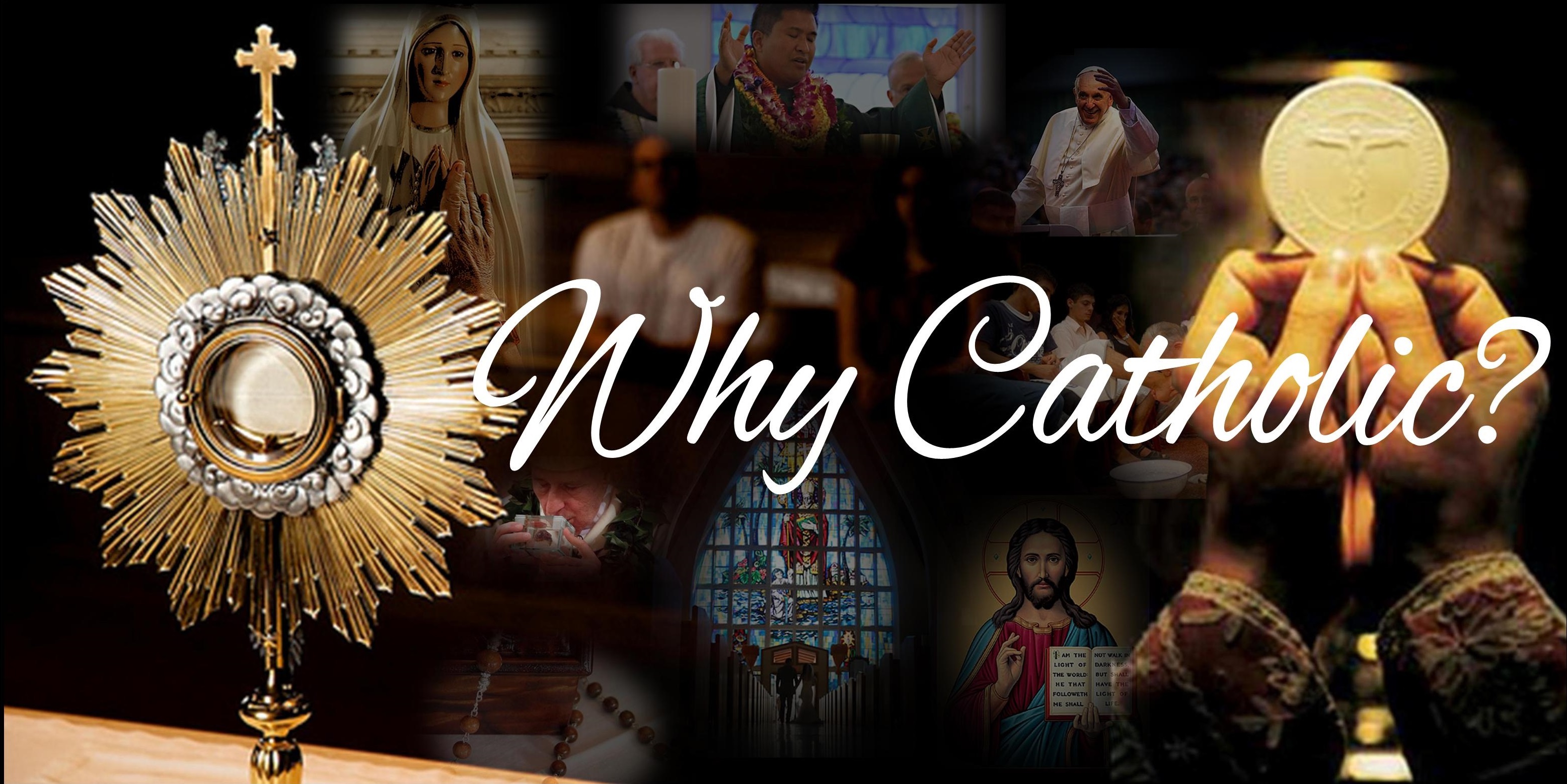
Why Be Catholic?


Dear Theophilous,

I’m what most people would consider a cradle Catholic, more or less. Shortly after I was born I was baptized at St. Anselm’s parish in Toronto. Even though it wasn’t their home parish, they had gotten married there, and thus the decision to have me baptized there. I don’t think any of us have ever been back to St. Anselm’s since.

I also have vague recollections of my sister’s baptism when I was 3, but most of my early childhood memories are of Sunday School at the local United Church. It wasn’t until I was 9 years-old and my mom went through the RCIA program that we started attending St. John Chrysostom and I made my first Reconciliation and Eucharist. From that point on, for all intents and purposes, was raised a cradle Catholic.

During those formative years, if you had asked me Why I was Catholic, I would have given the question about a 10-second thought before answering, “Because my parents are.” Actually, growing up in the Catholic school system, it just seemed natural that everybody and their parents (and their parents’ parents) were Catholic. It was just the natural order of things.

As I’ve been mellowing in my old age, however, I’ve been giving more and more thought to the question Why be Catholic? It’s a question I’ve heard discussed by a variety of different personalities on The Catholic Channel on SiriusXM, giving much food for thought. It’s a question I knew I had to answer once I saw it emblazoned on a banner in my mother-in-law’s parish in London, Ontario.

I know the answer, “Because my parents are,” will no longer hold water when it comes to defending my Catholic faith, so I narrowed it down to three key reasons:


  • The Eucharist
  • The Truth
  • My Family


The Eucharist

The Catechism of the Catholic Church rightly states that “The Eucharist is the source and summit of Christian life.” (CCC #1324) The Catechism tells us how all other sacraments, and all other life in the Church are bound up in the Eucharist and oriented toward it. How could they not be? This is the body and blood, soul and divinity of our Lord and Saviour. Really, the Eucharist is the be all and end all of what it means to be Catholic, and in my mind, what it means to be Christian.

Believing in the Eucharist isn’t easy. It never was. Even those who knew Christ and followed him daily had a hard time. During the Eucharistic Discourse in the Gospel according to St. John, when Jesus tells His followers they need to eat His flesh and drink His blood they grumble, “This is a hard saying; who can listen to it?” (Jn 6:60) And then when Jesus reiterated our need for the Eucharist, “many drew back and no longer walked with Him.” (Jn 6:66).

Knowing the Eucharist, understanding the Eucharist, loving the Eucharist; none of it is easy; but one you do, it is the most beautiful thing on Earth. I’ve heard it said that if we truly knew in our hearts what the Eucharist contained – wild horses could not keep us away from it. Some of the most profound moments in my life have come before the Blessed Sacrament, my heart physically pulled towards the Tabernacle; the ache of my suffering eased by the sacrifice on the altar; the tranquil warmth that fills me when I consume the Eucharist.

It is through the Eucharist that I love that I have come to know Christ’s love for me, a sinner.


The Truth

If the Eucharist is the source and summit of our faith, our faith hinges on a single question that Jesus asks us: “Who do you say that I am?” (Mk 8:29, Mt 16:15) How we answer that question changes everything. C.S. Lewis tells us we can answer this question in only in one of three ways: that Christ a liar, a lunatic, or He is Lord. Personally, I pick the third option each and every time.

Whenever defending doctrine or explaining a point of faith, I like to begin the discussion by asking this very question. The starting point with Christians is that He is Lord, God, one with the Father and the Holy Spirit. (If this isn’t the answer, there’s a whole other conversation that needs to take place). If Christ is God, then we have to take what He says as the Truth – like it or not.

Christ Himself tells us, “I am the way, the truth and the life.” (Jn 14:6) It’s not a boast – it’s a simple fact.

There are a lot of Christ’s teachings that are difficult, even more so now in the 21st Century than they were in the 1st Century (and look what they did to Jesus back then). When we propose that our truths are better than Christ’s, are we then not presupposing that we are greater than God?

The Truth that Christ gives us in His Gospel is like a beacon in the dark. The Truth guides us to the joy of eternal life in Him. The seas may be, and usually are, rough; but the guiding light of Christ’s love and Truth bring us to safety. Instead of binding us up, the Truth liberates us to not worry about the raging waters around us, but to take comfort in the safe harbour we are going to enter.


My Family

The joy of faith is not something to be kept in secret, a lamp hidden under a bushel basket; rather, it is to be shared freely. I love the expression: Don’t just keep the faith. Give it away!

I always teach my students that the true meaning of Love is “to want what is best for the other.” If I truly love my wife and if I truly love my son, how could I ever imagine to keep from them the beauty I have found in the Eucharist and the Truth? There is nothing I want more for them than the love of God.

This is how the faith has come down to us over 2,000 years. Passed from generation to generation, parent to child. I can’t think of any better gift I could give my son, a gift that will not only last a lifetime, but for all eternity.


Why Be Catholic? Is a question I had never given too much thought to, but it’s a question which defines who I am; who my family is.  This is a question I no longer run from, but embrace and am proud to answer.

Friday, July 11, 2014

Being a Donkey for Christ


Dear Theophilus,

A little over a year ago, when I was still teaching the World Religions course at my high school, I invited Asha Frost, a childhood friend to come and speak to my class about Native Canadian spirituality. Asha is a homeopath who has also studied Ojibwa spiritual and healing traditions, not only as a part of her practice, but also as a part of her own heritage.

Among many items, Asha bought in her medicine pouch and explained the meaning and significance behind each item, as well as its purpose in Ojibwa spirituality. After answering many questions, Asha led us through a smudging ceremony and a guided meditation, which proved to have some interesting results.

The guided meditation that Asha took us through involved getting in touch with our inner animal spirit. In a similar way to how a Catholic guided meditation will help us calm our souls and lead us to Christ, Asha took us on a calming journey through the forest to meet an animal spirit that was waiting there for each individual. Not everyone in the room met up with their animal spirit, those that did shared that they had met up with deer, wolves and even a black panther. Of course there was the expected snickering when I shared with the class that I had met up with a donkey (the snickering was probably egged on by the fact that I played to my 16 year-old crowd by using the synonym for donkey that also describes my posterior).

I didn’t think much more of my spiritual meeting with the donkey as Asha finished her presentation and answered the kids’ questions, but I have pondered its meaning off and on over the past months. Wanting to dig a bit deeper, I did a little research, and was surprised by what I found out.

The donkey is considered to be among the most gentle and humble of all the animal spirits. An attachment to the donkey spirit signifies a spirit of servitude and wanting to help others. I also learned that of all the animal spirits in Native Canadian spirituality, the donkey is the one that is linked to Christ.

When I thought about it, this made perfect sense. Christ himself taught us that if we want to be great in the ways of God, we need to humble ourselves in servitude to others - that is why after he washed the Apostles’ feet at the Last Supper Christ said, “I have set you an example, that you should also do as I have done for you. Very truly I tell you, servants are not greater than their master, nor are the messengers greater than the one who sent them.” (John 13:15-16)

Something else about the link between Christ and the donkey absolutely floored me. Through my research I learned that all donkeys have a very particular marking on their shoulders. On their grey hair, donkeys have a dark brown line that runs along their neck and spine, while another dark brown line runs across their shoulders, forming a cross on its shoulders. It’s little wonder that the teenager at the local petting-zoo looked at me funny out of the corner of his eye as I excitedly pointed this out to my wife.

The cross on the donkey’s shoulders is just in front of where one would sit if they were riding this humble and docile beast. It would have been this cross that Mary would have looked at during the long ride from Nazareth to Bethlehem, as well as Christ as he rode triumphantly into Jerusalem; reminding both of them both of his merciful mission for humanity.

The more I meditate on my meeting with the donkey, the more I realize I want to be like him. Not only do I need to strive to be more Christ like, humble and servile; but I want to be like the donkey, carrying Christ to the world.

Tuesday, January 21, 2014

Mike's Prayer


Dear Theophilus,

As parents my wife and I are constantly wondering how we’re doing in raising our son. We sometimes find that we’re asking ourselves: “Are we getting it right?” Every so often our nine-year-old son Michael comes up with something that tells us that the answer is a resounding “Yes!”

This past Monday was one of those moments. As I was sorting through the myriad of papers (tests, letters, homework, etc.) that he had stuffed in his backpack, I came across a prayer he had written. I was astounded by what he had written. So with his permission, I’ll share it with you here:

Dear Lord, God,

Help us face the many abysses of evil.
Lord, thank you for our families and friends.
If we have disobeyed you in the past days of the New Year,
please let us remember that we are "all yours".
We are not perfect and let us not be judged in life by those who need prayers.
Help us know that you are there.

Amen

Needless to say I was absolutely floored. Days later I’m still amazed at how he understands his relationship with God can be on so many different levels. Michael’s prayer reminds us of how we need God in every aspect of our lives:

Protection from evil;
Thanksgiving for the many blessings in our lives;
Repentance for our sinfulness;
Acknowledgement that we must help one another through prayer; and
A longing to know God.

Our Catholic faith is a dynamic part of who we are as a family. We try to infuse it in everything that we do, from great family celebrations to the most mundane of daily chores. Between evening sports activities, homework and friends, we wonder sometimes if the message is getting through. It’s in moments like these that my wife and I know that God is working through us.


Friday, November 29, 2013

You don't eat meat?


Dear Theophilus,

A few weeks ago I was honoured to attend an event being held for a good friend’s brother. With my friend being of Italian heritage, there was quite a spread set out when it was time to eat: lasagne, alfredo pasta, veal, sausage, rapini, Caesar salad, and on the table went. Unfortunately for me, it was Friday, but I still quietly loaded up on the vegetarian options. As I got to the end of the table, an older gentleman asked me, “What, no veal? No sausage?” To which I simply answered, “Hey, it’s Friday.” After he had swallowed his amazement, my new found friend replied, “Yeah? I try to do that too.” That was all that was needed to be said, and then we went our separate ways.

I know the Catholic Church no longer obliges the faithful to fast and abstain from meat on Fridays. In fact, the only obligatory days of fasting and abstinence are Ash Wednesday and Good Friday (cf Youcat #345, CCC #2042-2043). In Canada, the Canadian Conference of Catholic Bishops teaches that although Fridays are still considered a day of abstinence, if one performs a particular act of charity, penance or piety outside of their normal behaviour, this can replace the act of abstinence.

Still, I try to follow the old rule of abstaining from meat on Friday. It may seem archaic, but I see it as doing my part in keeping God’s covenant. Despite all of my sins and shortcomings, I know God still loves me, and He forgives me through the sacrament of reconciliation. So really, is going a day without meat too much to ask on my end?

Much like Eleazar, who refused to even pretend to eat swine’s flesh to save his own life (cf 2 Macc 6:18-31), I too could probably fake it. Use my morning prayers as a sign of piety, or drop $5 in the poor box so I can have wings with my Friday beer. But I’ll know, and more importantly God will know that I’m just looking for a loophole in his Covenant law.


Although it may be awkward at times, I’ll continue try to be like Eleazar, trying to keep up my end of the Covenant. However, as a seafood lover, the difficulty won’t be in the abstaining from meat, but rather in the explaining why.

Monday, September 3, 2012

Thoughts on the Year Ahead in my Catholic Classroom


Classroom in catholic school in Argentina Stock Photo - 2629500

Dear Theophilus,

Although I like to take time on Labour Day weekend to look back at the blessings that summer vacation has brought: a new puppy to our family, Michael’s week at Totus Tuus, and the many hours spent together as a family; I also like to use the week and days leading up to a new school year to reflect on the possibilities that lie ahead to set myself a goal as a Catholic teacher.

This year I would like to make the Catholic Education in my classroom just that, more Catholic.

I came to this decision for a number of reasons and from a number of different angles.

Firstly, Pope Benedict has declared this to be the Year of Faith for the Catholic Church starting in October 2012. I can’t think of a better way to celebrate the Year of Faith than by deepening my own faith and helping others to deepen their own. Of course this is a part of my job description as a Catholic Educator, but a lot of times faith takes a backseat to curriculum in my classroom.

Secondly, one of the instructors from my summer course on religious education directly challenged us to put into words how our Catholic classrooms are different from the classrooms of the public school across the street. When it comes right down to defending Catholic education, he told us, this would be the question posed in court – how are Catholic schools (and their classrooms) different. Many of my colleagues would begin to talk of Gospel values and social justice, but I fear that our public counterparts would be able to make the same claims under citizenship and moral ethics. In my History and Geography classroom I want to teach Catholicism from its core so my students can articulate what Catholic teachings are founded on and where Catholic teachings can take us to make a better society for everyone.

Thirdly, I had the wonderful opportunity this past summer to meet with Cardinal Archbishop Collins of Toronto. His Eminence was so gracious in his demeanour and so passionate about Catholic education that I couldn’t help but be moved by the same passion to infuse my Catholic classroom with faith.

Finally, publicly funded Catholic education in Ontario seems to be under attack more now than ever before. With our provincial government braying for cutbacks to public education expenses, one of the first items on many cost-effective lists is the amalgamation of Catholic school boards with their public (secular) counterparts. Yes, duplicity does seem unnecessarily expensive on the surface, but at what cost to the moral fabric of society by removing Catholic teaching out of the public forum (here it seems as though I return to my second argument – we need to show how Catholic education is not only different, but beneficial). This will be all the more important in Ontario Catholic schools this year as Gay-Straight Alliances promise to make their appearance in our schools and Catholic teaching will come under direct media scrutiny.

What do I propose to do?

I know I cannot change the system, nor my style, overnight and that baby steps are needed. I hope to make signs of our Catholic faith more visible in my classroom. I’m also re-inventing some of my assignments to reflect Catholic social teachings, their history and their guiding principles. For example, when we study the development of the social movement in Canada (workers’ rights, women’s suffrage, etc.) or the unequal distribution of global wealth, I want to challenge my students to find what the Catholic Church teaches on these subjects through papal encyclicals. I also intend on becoming more involved in the chaplaincy program at school with the goal of helping increase a sense of the sacred for my students – taking Catholicism beyond simple social justice.

Will I be a roaring success in changing the tone of Catholic education? I hope so, but I doubt it. I know that there will be times when I succeed, but there will also be times when I fail in the knowledge and courage needed to carry out God’s calling as a Catholic teacher. It’s for those times when I falter that I ask you to pray for me and the students entrusted to my care.

Wednesday, August 8, 2012

Athletic Signs of Faith


Dear Theophilus,

Although I’m far from being an Olympics junkie, I’ve managed to watch an event here and there, usually while having my morning coffee. Watching the Men’s 100m heats the other day I was pleasantly surprised to watch Usain Bolt cross himself and point skywards as he settled into the starting blocks. It was as if he were telling God that what he was about to do was for Him.

Bolt isn’t the only elite athlete that I’ve noticed doing this lately. Recently Luis Leon Sanchez of Spain made the sign of the cross as he won the 14th stage of the 2012 Tour de France. Also, as a soccer junkie, I’ve noticed many players making the sign of the cross as they enter onto the pitch at the beginning of a game or as a substitute – most of them from countries where the Catholic faith is still strong: Italy, Spain and Latin America.


When I was a young boy, I remember watching my hockey hero, Guy Lafleur, make the sign of the cross before starting a hockey game and I asked my mother why he would do that if he wasn’t in church. She told me that it was a superstitious thing that athletes do. Personally, I think it goes further than that. Just like Usain Bolt seems to be telling God that he is seeking perfection through his athletic talents, I think other athletes are also saying a special prayer to God for one reason or another. Whether it’s asking God for strength and courage before the match begins or giving Him glory after a goal or a victory, these prayers are a way for athletes to recognize God’s role in what they do.

Reflecting on this got me to thinking about my own life, my own profession as a catholic educator and how I pray to God as I go about my day-to-day routines. Do I visibly ask God for strength and courage as I begin my day, students filtering into their seats? Some days I need it more than others. Do I give thanks to God after giving a particularly good lesson or helping a student understand a concept they were having difficulty with? If it were not for the talents God gave me, my successes would not be possible.

As we revel in the athletic exploits of the Olympics, I think we need to learn a thing or two from the athletes. We need to turn to God in our day-to-day lives, remembering to lean on Him when times are hard and to give Him glory when things go well; and finally, not to be afraid to show it.

Friday, November 11, 2011

Remembering

Dear Theophilus,

Greater love has no one than this, that he lay down
his life for a friend. (John 15:13)

Today, around the world, we gather to remember those who
laid down the greatest gift from God so that others could revel in the joys of
life. As I do every year during that moment of silence not only do I say a
prayer of thanks for those who made the ultimate sacrifice, I ask myself if I
could do the same. A very difficult question, indeed.

Watching the Remembrance Day ceremony from the national
cenotaph in Ottawa at home with a sick 7 year-old, I was moved by the crowds
cheering our war veterans and the deep understanding of sacrifice my son
showed. There was one simple gesture by a dignitary, however, that caught my
eye. As the representative of the Parliament of Canada laid a wreath at the
tomb of the Unknown Soldier, he paused and made the sign of the Cross. A
courageous act in a defiantly politically correct society.

It has been my experience that Catholics often feel the need
to apologize for their demonstrations of faith. We either furtively make the
sign of the Cross with a flick of fingers under their chin, or remove Christian
artwork when non-religious friends and relatives come for dinner. Really, we
should act to the contrary, taking courage from others and not be afraid to
show our Catholic faith to world.

With so many people lamenting the loss of morals in
our society, showing that we are not afraid to live a faith-based life is the
first, albeit small, step towards building a better society. The kind of
society that the many young men and women we remember today died for.