Showing posts with label eternal life. Show all posts

Friday, August 26, 2016

Daily Opportunities for Sainthood


Dear Theophilous,

We’re all called to be saints, and considering the alternative, who wouldn’t want to be one? That said, the goal of sainthood can seem a daunting one (as it truly is). Unfortunately when most of us look at the examples that have gone before us, we give up before even trying.

The good news is that God calls each of us to sainthood in our own unique way. Yes, some saints are called to be exemplary witnesses to the faith, but the vast majority of us are called to be a witness to sainthood in our daily lives. Thanks be to God that we can be saints in our daily life – I’m not sure if I’m cut out for the trials others have had to go through.

Opportunities for a saintly life abound all around us. We just need to be reminded sometimes of where to look for it.


Prayer

The first step on the path to sainthood is to deepen your relationship with God. Just like our earthly relationships, our relationship with God is fed with good communication. The same as any friendship, it’s not enough to just bring our worries, needs and desires to Him; we need to listen to what God is saying to us as well. We have all had a relationship where one person constantly takes, while the other does nothing but give.  Experience tells us that this kind of relationship can’t last. Thankfully our God is not like this, and it’s usually us who turns our back on Him and not vice-versa.

Some saints would spend hours daily in Eucharistic adoration; most of us don’t have the luxury of this kind of time. Our daily vocations put demands on our time, but this doesn’t mean we can’t set aside time for God (we do it for our spouse, kids, friends and work – so why not for God?). Increasing our time and prayer and being aware of His answers, we cannot want but to spend more time with Him and marvel at the way He works in the world.


Penitential Suffering

At one point or another in their short lives, Catholic children have heard the expression: Offer it up! It’s the Catholic parent’s standard reply any time a child begins to whine. But there’s something to be said about penitential suffering, and bearing our daily challenges with grace.

In our fallen human state, we can’t choose not to suffer, but we can choose how we deal with our sufferings. And honestly, our daily sufferings do add up. From the aforementioned whiny child, to the annoying co-worker, to the neighbour’s barking dog, to the stone in our shoe, to the… to the… to the… There’s no escaping it.

When we let these little challenges get to us, they become insurmountable and we become miserable. When we accept these obstacles with grace, persevering quietly in our suffering, we become a witness to the peace that Christ brings us.

How does our suffering become penitential? Offer it up! Offer your suffering for the greater good. Offer your suffering as a prayer for someone who needs it, for the souls in purgatory, for the conversion of sinners. At the very least, offer your suffering up for the atonement of your own sinfulness.

At the end of the day, misery loves company; yet peace is contagious - just imagine the difference you can make in the world by suffering through your next headache with grace.


Evangelization

Sainthood is all about getting ourselves and others to heaven. In the great commissioning, Christ exhorted us to “Go into all the world and proclaim the Gospel to every creature.” (Mk 16:15) If we are to be Christ’s disciples, we are challenged to bring others to Him.

This doesn’t necessarily mean that we all need to get up on our soapbox on the street corner (though some are called to do this), we can evangelize in many different ways in our daily lives. Being a witness with your life can be the greatest evangelization tool of all. It suffices to ask yourself some of the following questions:

  • How do I interact with others around me?
  • How do I treat the unfortunate that come into my life?
  • Do I teach my children to pray?
  • Do I have the courage to pray in public?
  • Do I answer the questions/challenges put to my faith?
  • How do I dress?
  • What TV shows do I watch with family/friends?
  • What comes out of my mouth when I’m frustrated?
  • What music plays on my car radio?
  • What websites do I surf when no one is at home?

This kind of examination of conscience can go on much longer. The point is to become more aware of aligning our lives to Christ.


Sainthood won’t be easy. Jesus even told us that to get to heaven we will need to pick up our Cross. (cf Mt 16:24) We may never be officially recognized as a saint, but by seizing our daily opportunities for sanctity, we can become every day saints.


Wednesday, August 17, 2016

Answering the Call to Sainthood


Dear Theophilous,

If you’re not shooting for sainthood, you’re aiming too low!

It’s the truth! A saint is someone who, after this earthly existence, is spending eternity in heaven. And seriously, if your goal in this life isn’t to get to heaven, my understanding is that the other destination is a lot less pleasant.

Unfortunately, many of us, even the most devout of Christians, don’t see ourselves as saints. Perhaps it’s in our fallen nature to dwell on our own sinfulness. Maybe when we compare ourselves to the saints that have gone before us, we feel we just can’t measure up. There’s a certain discomfort we feel when we’re put on a pedestal, just like the statues in the church vestibule. Personally, I know I will be found lacking when held to such a high standard.

Still, the God who knows us, the God who loves us, calls us to Himself; He calls us all to be saints.


Sainthood is for everyone

In its wisdom, the Catholic Church understands that, although we are sinners, we are all called to be saints; we are all called to holiness. This call began with the creation of Adam and Eve, and their task to tend and guard the garden (cf Gen 2:15). God’s invitation to holiness was extended once more through Jesus Christ when he called the disciples to himself (cf Mt 4:18-22). Once again, in our own time, the Church has made the universal call to holiness:

Therefore in the Church, everyone whether belonging to the hierarchy, or being cared for by it, is called to holiness, according to the saying of the Apostle: "For this is the will of God, your sanctification". (Thess 4:3) (LumenGentium 39)

Yet many of us balk at the contemporary call to sainthood. We look to the saints that came before us, fear we won’t make the cut, so we quit before we even try. The truth of sainthood is startling though. If we look at a history of saints, we soon realize that most of them were not holy from birth; that they required a conversion of heart. The Church itself was founded on sinners:

St. Peter denied Christ;
St. Mary Magdalene was a prostitute; and
St. Paul murdered some of the first Christians.

The list is endless. A great read to know you’re not alone in your sinful start to sainthood is Thomas Craughwell’s Saints Behaving Badly.

Why does God use sinners to become saints? He wants us to take solace in knowing that nothing is impossible with God – even with ourselves.


Sainthood starts now

As the saying goes, There’s no time like the present to get started on your way to holiness. Most of us won’t have a conversion experience like St. Paul, but that doesn’t mean we can’t have a conversion of heart. We are all called by name, the question is: will we answer the call.

We might not always recognize them, but these calls are ever-present in our lives. They are not always big and brazen, the Lord rarely works like that, but they are usually a small nudge to get us going back in the right direction. It could be a near miss on the highway, a miscommunication that blows up at work, or a lifestyle choice that leads us to harm. I once heard these small nudges referred to as a Purgatorial Pinch. Once we recognize them, we can use these moments to re-boot our path to sainthood.

Whenever she wants to try to bring me down a notch, my own mother often reminds me of my misspent youth with a quip I know where you come from and I know what you’ve done. My pat answer to this remark is a steadfast: In the journey towards heaven, it’s not where we come from that counts, but where we’re going. I know exactly what my sins are; so does the Lord. I confess and I reconcile with Him, confident He will show me the way.

It’s in recognizing our faults that we become repentant and re-orient ourselves towards God. As any sinner will tell you, the road to sainthood is long and arduous. From time to time we may slip or lose our way. What matters is getting back on the right path so we can arrive at our destination.

It’s never too late to get on the road to sainthood (cf Mt 20:1-16), but NOW is always the best time to get started.


Sainthood is a community

Teaching catechesis in both French and English, as well has having a command of both Portuguese and German to varying degrees, I love to play with language. I’m constantly looking for the ways in which God uses language to bring us closer to him. Something I enjoy pointing out to my students is the compound make-up of the word community from the French “comme” and “un”; meaning “as one”. So when we profess in the Creed that we believe in the communion of saints, we are professing our belief in our oneness with those who are in heaven.

Knowing that we are as one with the saints, both those in heaven as well as the ones still here on earth, gives us great courage. Life is difficult, and our path towards heaven is hard – we can’t do it alone. Thanks be to God that we have the communion of saints to see us through.

We all have our favourite saints for various reasons. Most of us find a personal call to devotion to one saint or the other; some popular, while others are more obscure. I have found that the internet is littered with devotions to the saints that have gone before us. There are Twitter Novenas or virtual candles at countless websites to bring us in closer communion with the saints. All designed to help bring us closer to God. Personally, I enjoy reading brief bios of the saints of the day; finding inspiration in their stories and strength from their words of wisdom.

We can’t forget about the saints here on earth, the saints who walk among us in our everyday lives. Yes, my generation has been blessed to be personal witness to the lives of St. Teresa of Calcutta and St. John Paul the Great, but we need to remember the communion of saints that we spend our days with.

Our family is our first encounter with the communion of saints. When we were married 20 years ago, my wife and I were charged with getting each other to heaven. Now that we are blessed with a son, it’s our responsibility to get him there to. We can’t stop there, however, and we need to recognize the holiness in the others around us – family, friends, colleagues, neighbours; no matter how hard that can be at times.

We live in a communion of saints. We need to rely on each other, but we also need to encourage each other on our path to sainthood.


Sainthood is infectious

Once we decide that our own sainthood is possible, no matter how tarnished our past, we will see it begin to rub off on others. When we decide that now is the time to make a change, others will like what they see and will follow suit. It’s living in this communion of saints that we will begin to see that the universal call to holiness is infectious.

Our little actions of sanctity can go a long way in helping create other saints around us. A simple please or thank-you; letting someone into your lane in rush hour; stopping to talk and listen to a neighbour going through a rough time – each of these will have a greater effect on the other than a sense of entitlement, blaring horn or cold shoulder. When we are saintly two things will happen, we will draw other saintly souls towards ourselves, and, more importantly, we will cause the conversion of the hearts in those we meet.


Following the news in the world today, it’s more than obvious that the world needs saints. Heed the call to holiness. Know that you can become a saint.

Monday, December 7, 2015

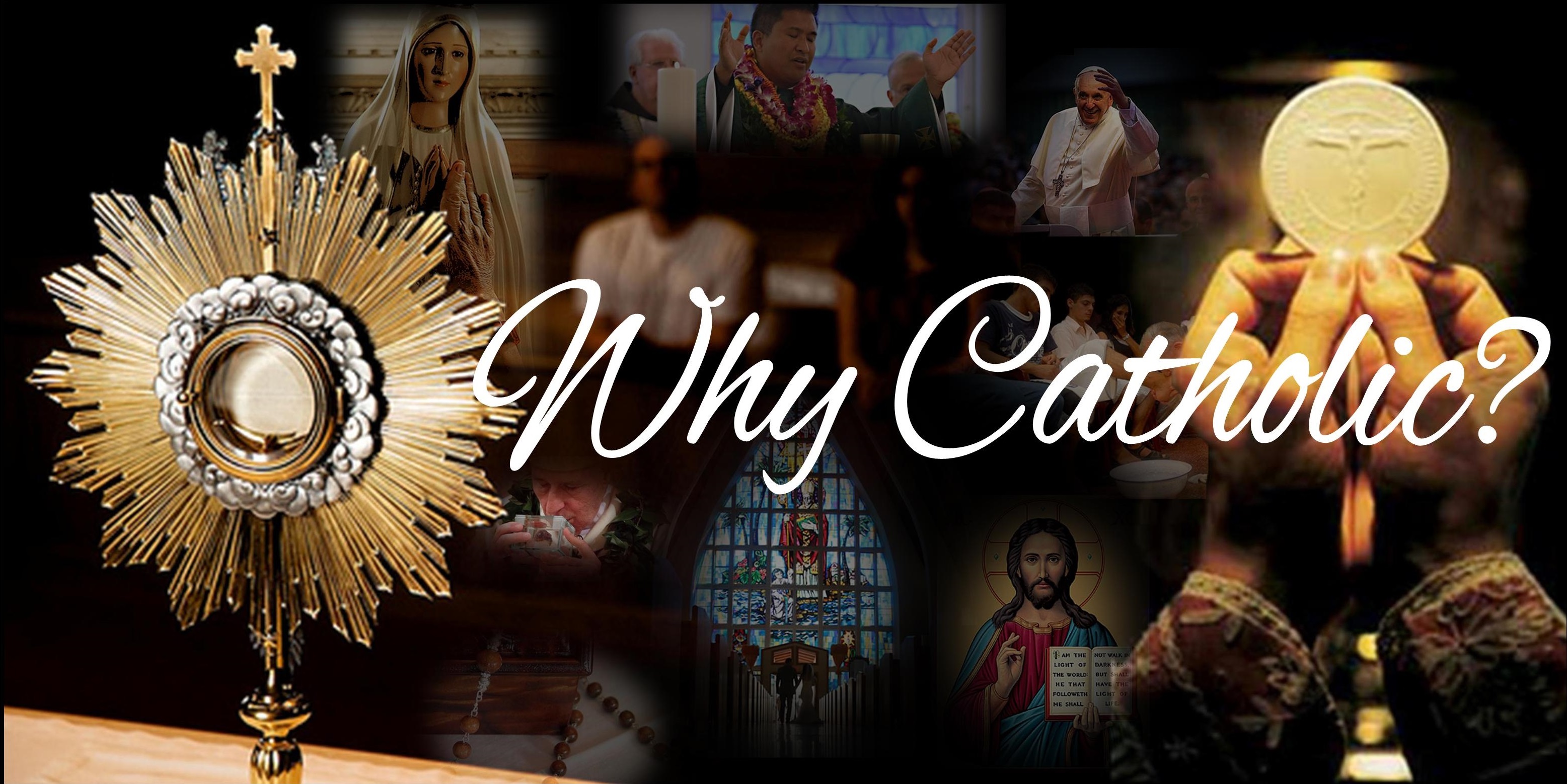
Why Be Catholic?


Dear Theophilous,

I’m what most people would consider a cradle Catholic, more or less. Shortly after I was born I was baptized at St. Anselm’s parish in Toronto. Even though it wasn’t their home parish, they had gotten married there, and thus the decision to have me baptized there. I don’t think any of us have ever been back to St. Anselm’s since.

I also have vague recollections of my sister’s baptism when I was 3, but most of my early childhood memories are of Sunday School at the local United Church. It wasn’t until I was 9 years-old and my mom went through the RCIA program that we started attending St. John Chrysostom and I made my first Reconciliation and Eucharist. From that point on, for all intents and purposes, was raised a cradle Catholic.

During those formative years, if you had asked me Why I was Catholic, I would have given the question about a 10-second thought before answering, “Because my parents are.” Actually, growing up in the Catholic school system, it just seemed natural that everybody and their parents (and their parents’ parents) were Catholic. It was just the natural order of things.

As I’ve been mellowing in my old age, however, I’ve been giving more and more thought to the question Why be Catholic? It’s a question I’ve heard discussed by a variety of different personalities on The Catholic Channel on SiriusXM, giving much food for thought. It’s a question I knew I had to answer once I saw it emblazoned on a banner in my mother-in-law’s parish in London, Ontario.

I know the answer, “Because my parents are,” will no longer hold water when it comes to defending my Catholic faith, so I narrowed it down to three key reasons:


  • The Eucharist
  • The Truth
  • My Family


The Eucharist

The Catechism of the Catholic Church rightly states that “The Eucharist is the source and summit of Christian life.” (CCC #1324) The Catechism tells us how all other sacraments, and all other life in the Church are bound up in the Eucharist and oriented toward it. How could they not be? This is the body and blood, soul and divinity of our Lord and Saviour. Really, the Eucharist is the be all and end all of what it means to be Catholic, and in my mind, what it means to be Christian.

Believing in the Eucharist isn’t easy. It never was. Even those who knew Christ and followed him daily had a hard time. During the Eucharistic Discourse in the Gospel according to St. John, when Jesus tells His followers they need to eat His flesh and drink His blood they grumble, “This is a hard saying; who can listen to it?” (Jn 6:60) And then when Jesus reiterated our need for the Eucharist, “many drew back and no longer walked with Him.” (Jn 6:66).

Knowing the Eucharist, understanding the Eucharist, loving the Eucharist; none of it is easy; but one you do, it is the most beautiful thing on Earth. I’ve heard it said that if we truly knew in our hearts what the Eucharist contained – wild horses could not keep us away from it. Some of the most profound moments in my life have come before the Blessed Sacrament, my heart physically pulled towards the Tabernacle; the ache of my suffering eased by the sacrifice on the altar; the tranquil warmth that fills me when I consume the Eucharist.

It is through the Eucharist that I love that I have come to know Christ’s love for me, a sinner.


The Truth

If the Eucharist is the source and summit of our faith, our faith hinges on a single question that Jesus asks us: “Who do you say that I am?” (Mk 8:29, Mt 16:15) How we answer that question changes everything. C.S. Lewis tells us we can answer this question in only in one of three ways: that Christ a liar, a lunatic, or He is Lord. Personally, I pick the third option each and every time.

Whenever defending doctrine or explaining a point of faith, I like to begin the discussion by asking this very question. The starting point with Christians is that He is Lord, God, one with the Father and the Holy Spirit. (If this isn’t the answer, there’s a whole other conversation that needs to take place). If Christ is God, then we have to take what He says as the Truth – like it or not.

Christ Himself tells us, “I am the way, the truth and the life.” (Jn 14:6) It’s not a boast – it’s a simple fact.

There are a lot of Christ’s teachings that are difficult, even more so now in the 21st Century than they were in the 1st Century (and look what they did to Jesus back then). When we propose that our truths are better than Christ’s, are we then not presupposing that we are greater than God?

The Truth that Christ gives us in His Gospel is like a beacon in the dark. The Truth guides us to the joy of eternal life in Him. The seas may be, and usually are, rough; but the guiding light of Christ’s love and Truth bring us to safety. Instead of binding us up, the Truth liberates us to not worry about the raging waters around us, but to take comfort in the safe harbour we are going to enter.


My Family

The joy of faith is not something to be kept in secret, a lamp hidden under a bushel basket; rather, it is to be shared freely. I love the expression: Don’t just keep the faith. Give it away!

I always teach my students that the true meaning of Love is “to want what is best for the other.” If I truly love my wife and if I truly love my son, how could I ever imagine to keep from them the beauty I have found in the Eucharist and the Truth? There is nothing I want more for them than the love of God.

This is how the faith has come down to us over 2,000 years. Passed from generation to generation, parent to child. I can’t think of any better gift I could give my son, a gift that will not only last a lifetime, but for all eternity.


Why Be Catholic? Is a question I had never given too much thought to, but it’s a question which defines who I am; who my family is.  This is a question I no longer run from, but embrace and am proud to answer.

Tuesday, September 1, 2015

The Gate is Narrow and the Way is Hard


Dear Theophilous,

Every week when the local paper shows up at the door, one of the first things I do is flip to the back and scan the obituaries. Whenever I get caught doing this I’ll glibly reply that I was just making sure my name wasn’t there and I can continue breathing.

Joking aside, I have noticed an interesting trend from obituary writers, most of who use opening lines such as:

… has gone to reside in the Lord.

… has become another angel in heaven.

…has joined mom/dad in heaven.

Reading the obits these days, it seems as though everyone gets into heaven and no one is going to hell. Don’t get me wrong, I am not saying that we all don’t go to the Lord, we do since He is our final judge, but it seems that we think we have already figured out what His verdict of our loved ones will be.

This is our calling, and this is our hope; that we will be reunited with our Lord in paradise. This is something I pray for everyday; for myself, for my family, for my friends and for those who have no one to pray for them.

Yet, in a world that’s rife with evil, we need to acknowledge the existence of hell. We need to recognize that not everyone accepts the will of God. We need to understand the truth behind one of Christ’s most difficult teachings; a lesson I’m certain it pained him to share:

Enter by the narrow gate; for the gate is wide and the way easy, that leads to destruction, and those who enter by it are many. For the gate is narrow and the way is hard, that leads to life, and those who find it are few. (Mt 7:13-14)

This teaching of Christ struck me recently while I was reflecting on my misspent youth, and I realized the irony of the titles of two of my favourite songs from my teenage years: Highway to Hell and Stairway to Heaven. It seems these two rock bands understood Christ’s teaching on traffic flow. Even within the songs’ lyrics we can see hints as to cosmic battle for souls:

No stop signs
Speed limit
Nobody's gonna slow me down
Like a wheel
Gonna spin it
Nobody's gonna mess me around
Hey, Satan
Payin' my dues
Playin' in a rockin' band
Hey, mamma
Look at me
I'm on the way to the promised land

I'm on the highway to hell
Highway to hell

(excerpt – Highway to Hell – AC/DC – 1979)


To which the answer would be:

If there's a bustle in your hedgerow, don't be alarmed now,
It's just a spring clean for the May queen.
Yes, there are two paths you can go by, but in the long run
There's still time to change the road you're on.

(excerpt – Stairway to Heaven – Led Zeppelin – 1971)


Intentional or not, these songs fit so nicely into Jesus’ teaching on salvation.

The pathway to destruction is wide and easy, very much like a highway. Although it may not be the Autobahn without a speed limit, once we get rolling along that highway to perdition it becomes very hard to slow down, change lanes and take the off ramp. And Satan makes no bones about it, even though he promises you greatness and pleasure in this life, he promises neither joy nor comfort in the life to come.

The pathway to life is hard, just like spring cleaning or climbing a stairway that seems to go on forever (or an eternity). However, be not afraid, don’t be alarmed, because the May queen, Mary, is here to help. Christ’s mother draws us closer to Him with a simple phrase: Do whatever He tells you. (Jn 2:5)

There’s till time, dear Theophilous, for both of us, as well as the whole world, to change the road we are on; to find the narrow gate; to take the way that is hard; and to climb the Stairway to Heaven.

Monday, August 17, 2015

Numbers and the Bread of Life Discourse


Dear Theophilous,

I’m not someone who superstitiously puts a lot of faith in numbers. I don’t play the lottery. I won’t go out of my way to avoid the number 13. I don’t really have a favourite or lucky number (although throughout my entire recreational athletic career I have worn the number 7, that’s due more to the fact that when selecting my first ever hockey jersey I chose the sweater with the captain’s C on the front in a moment of 6-year-old vainglory). It’s just that I feel life is too short to spend my time worrying about how the numbers in my life will affect how my day plays out.

All this being said, I do love finding symmetry and patterns in the world around me; something that usually involves number games. One of my favourite number games is to find numerical links throughout Holy Scripture. A few of which (both obvious and obscure) include:

3

The Holy Trinity
The number of persons involved in Original Sin
The number of times God called Samuel
The number of persons involved in the Transfiguration
The number of angelic visits during the Nativity story

12

Tribes of Isreal
Apostles
Elect for Paradise (12x12=144x1,000=144,000)

40

Years the Israelites wandered in the desert
Days that Elijah spent on his journey
Days Christ spent in the desert
Days between the Resurrection and the Ascension

This list is very incomplete. I’m sure there are biblical scholars that have spent their careers looking at these numbers, interpreting them, commenting on them and sharing the wisdom these numbers impart.

As we work our way through the Bread of Life Discourse (Year B – Weeks 17-21 of Ordinary Time), there is another numerical coincidence that I find interesting, to say the least.

As a highlight of his teaching through the entire Bread of Life Discourse Jesus tells the crowds (and us):

Very truly, I tell you, unless you eat of the flesh of the Son of Man and drink his blood, you have no life in you. Those who eat my flesh and drink my blood have eternal life, and I will raise them up on the last day; for my flesh is true food and my blood is true drink. Those who eat my flesh and drink my blood abide in me, and I in them. Just as the living Father sent me, and I live because of the Father, so whoever eats me will live because of me. This is the bread that came down from heaven, not like that which your ancestors ate, and they died. But the one who eats this bread will live forever. (Jn 6:53-58)

The Bread of Life Discourse remains as difficult to swallow today as it was in the time of Christ:

Then the Jews began to complain about him because he said, “I am the bread that came down from heaven.” (Jn 6:41)

The Jews then disputed among themselves, saying, “How can this man give us his flesh to eat?” (Jn 6:52)

When many of his disciples heard it, they said, “This teaching is difficult; who can accept it?” (Jn 6:60)

Because of this many of his disciples turned back and walked with him no longer. (Jn 6:66)

It was during my meditation on the Bread of Life Discourse a couple of years ago that this last line caught my attention for it’s numeric value, for which I feel it bears repeating, but with a slightly different emphasis:

Because of this many of his disciples turned back and walked with him no longer. (Jn 6:66)

I doubt that it would take much commentary to make the link between the Scripture context and its numeric value. Disciples no longer walking with Christ in a verse numbered 6:66 … a number associated with Satan (the Beast) in the Book of Revelation (cf Rev 13:18). It is Christ who calls us to abide in Him through the Eucharist, His very flesh and blood; and Satan who pulls us away.

More telling is the exchange Jesus has with His Apostles immediately after the other disciples left Him:

“Do you also wish to go away?” (Jn 6:67)

To which Simon Peter replied:

“Lord, to whom can we go? You have the words of eternal life.” (Jn 6:68)

Through His loving grace the Father has given us the gift of freewill. When Christ calls us to Him in the Eucharist it is for us to decide whether we will fall away and walk with Him no longer, or will we turn to Him because He has the words of eternal life.

Friday, August 22, 2014

Bless You - It's Not Just for Sneezes


Dear Theophilus,

I’ve been getting a few strange looks lately. This is nothing new, really, I think the world has always seen me as a little off-kilter (when I came home from living in Belgium, I was in the habit of kissing male friends on the cheek instead of shaking their hand).

Lately, though, I think I’ve been making the people I meet in my daily travels a little uncomfortable. Although I’ve always tried to see the image of God in everyone that I meet (see my previous blog post on Greeting the Image of God in One Another), I find that sometimes I need to pinch myself as a reminder that God has a plan for each and every one of us in His Creation. So lately, when parting ways with someone, I try to say “God bless,” instead of “Goodbye,” or “See you later.”

Family, friends and colleagues have hardly batted an eye at this new expression that I’ve added to my vocabulary. Some of them are probably surprised that I didn’t start saying “God bless” sooner. They know me, and they know that I’m on a never ending quest to not only make God the centre of my life, but the centre of everybody else’s life as well (or at least plant the seed of Christ in their hearts). When parting ways with family and friends with a “God bless”, I am increasingly being met with a “God bless you too.”

It’s the strangers in my world that seem to be a bit taken aback by the words “God bless.” Whether it’s at the check-out counter at the grocery, hardware or convenience store (or bus, or restaurant, or wherever else I happen to have a short conversation with someone); once I receive my change and we are parting ways, I’ll say, “God bless.” These two little words and a brief moment of eye contact are usually followed by a blank stare and an awkward silence. After this momentary hiccup, some will smile back, while others will simply turn away to the next person in line.

In many ways, I understand this discomfort when confronted with the words God bless. Western society has trained us not to talk about God. Since everything in the world today has become relative, it comes as no surprise that God has become relative too, and He is something (not even someone) reserved for our private lives, not to be mentioned in public. Yet, there seems to be a strange comfort that comes across the faces of the people I meet when His name is spoken; like we’ve shared a great secret that shouldn’t be talked about in the open, but we wish we could. With the others, those who look confused, scared or indifferent; at least I know I have planted a seed with them, and with time and proper nurturing, hopefully this seed will grow into something great.

The other little expression that I have that raises eyebrows until people get used to it is “God willing.” As I leave school at the end of the day, invariably someone will say, “See you tomorrow,” to which I always answer, “God willing.” I think it’s a bit of a culture shock for most to openly admit that, like everything else, our comings and goings are dependent upon God, even the more devout Catholic teachers that I work with found this troubling at first. Especially when we are younger (which seems to be 80 and under these days), we all assume that we will be back at work tomorrow, that we hold our destinies in our own hands, and that it’s the decisions we make that bring us back. Truly, however, God has a plan for us, and if that plan does not involve work tomorrow, then we will not be there. One of the best laughs I’ve ever had at school was upon arriving one morning and a colleague looked me straight in the eye and said, “I guess God wanted you back here today too.”

A final thought on the words we use when we take leave of one another; my Portuguese father-in-law refuses to say “Adeus” (Adieu or Adios) when saying goodbye, he would much rather say, “See you later.” For my father-in-law, saying Adeus means that the next time we’re together, it will be in the presence of God and not on this earth; something he’s not ready for yet.

I do fervently hope, though, to one day be in the presence of God with my father-in-law, my wife, son, the rest of my family and all those who are created in His image.

God willing.

Monday, June 24, 2013

The Quintessential Question of our Faith


Dear Theophilus,

In this past week’s Gospel reading (Lk 9:18-24), Christ asks the quintessential question of our faith:

“Who do you say that I am?” (Lk 9:20)

Our entire faith hinges on how we answer this very pointed question.

If, like Peter, we answer: “The Christ of God.” (Lk 0:20), then everything else should fall neatly into place. There can be no further questioning of our faith. There certainly should be no further questioning of what we believe in or how we act morally and theologically.

Christ is asking us to either accept him for all that he is, or to reject him.

It’s on this question that the arguments of our Christian brethren that feel they can pick and choose Christ’s teachings that are relevant to them begin to fall apart. For, if they cannot accept all that Christ teaches, then how can they consider him to be The Christ of God?

How can we not consider the Eucharist to be the source and summit of our faith when Christ told us “I am the living bread that came down from heaven. Whoever eats of this bread will live forever; and the bread that I will give for the life of the world is my flesh.” (Jn 6:51) if he is not The Christ of God?

If Jesus is truly The Christ of God, then how can we not consider the teaching of the Catholic Church to be divinely inspired when, appearing to the disciples after the Resurrection, Jesus said to them “’Peace be with you. As the Father has sent me, so I send you.’ When he had said this, he breathed on them, (Jn 20:21-22) a commissioning that continues to this day in the conferring of the sacrament of priesthood. A priesthood in the Catholic Church commissioned when Christ said: “You are Peter, and upon this rock I will build my church, and the gates of Hades will not prevail against it.” (Mt. 16:18)

The teachings simply fall into place once we truly understand what it means to answer Christ’s question like Peter did at his institution as the fist Pope: “You are the Messiah, the Son of the living God.” (Mt. 16:16)

The list of what becomes indisputable when we answer this question, Who do you say that I am? is too lengthy to discuss in a blog post, there are 2865 paragraphs in the Catechism of the Catholic Church. It’s all there, and if Jesus is The Christ of God, then each of those paragraphs makes perfect sense.

As Fr. Robert Barron puts it so well (as he always does) in his Catholicism Series, if we do not answer like Peter, then there is very little to differentiate Christianity from the other world religions. If Jesus is not The Christ of God, then he is little more than a prophet, like Elijah or Mohammed, who have had (or claimed to have had) a revelation from God. If Jesus is not The Messiah, the Son of the living God, then he is little more than a new Buddha who has fond another path towards enlightenment. If Jesus is not The Christ of God, then could he be the next incarnation of Vishnu, come to teach us how to attain Moksha?


This is the quintessential question of our faith. How you answer it forms the core of what you believe and compels you how to act on those beliefs. So,…

Who do you say that He is?

Thursday, April 11, 2013

The Burn of God's Love


Dear Theophilus,

The other day, I was asked for my opinion on what heaven and hell are like. As is par for the course in my classes, my answer seemed to leave my interlocutor more confused than when we started our conversation.

Good or bad, I explained, we are all called to spend our eternal lives with God.

With a puzzled look, I was then asked to clarify if evil people go to heaven. I don’t think my answer: “Yes and no,” really helped much, so I tried to clarify my perspective of heaven and hell, gleaned from Fr. Robert Barron’s Catholicism.

I find it always raises an eyebrow when I state that hell (along with purgatory) burns with the fire of God’s love.

The reason is this: those who are in a state of sin or who have turned away from God are not prepared for the light of His loving embrace in eternal life.

I’ll generally use two parallels to demonstrate my vision of purgatory and hell:

Purgatory is like a smelter. To transform a metal, such as gold, from the ore that’s mined from the earth to its pure form that we wear around our necks or on our fingers, the impurities need to be burned away. Our souls are like gold to God, and before He can adorn Himself with the brightness of our love for Him, the impurities of our sins must be burnt away – purged. Although I do my best as a human, I’m still a sinner, and I look forward to the burning fire of God’s love in purgatory so that I can rejoin the Lord that much quicker.

As for the souls in hell, they too burn at the touch of God’s love. I see the darkness of evil as much like the darkness of a movie theatre. Over the course of a film our eyes adjust to the darkness of our surroundings so that we can see not only the screen, but the others sitting around us. When we leave the movie theatre on a bright summer afternoon, we shield our eyes from the sun’s blinding rays – the same way that the light of God’s love in heaven is blinding to those who chose to live in the darkness of evil.

Put in these concrete, earthly terms, I find that most people begin to understand my original thought of how everyone is called to be in the presence of God, it’s just a question of how prepared we are for the light of His love.

Needless to say, I was struck dumb when, the day after this conversation, I read the Gospel reading of the day:

Jesus said to Nicodemus: “God so loved the world that he gave his only Son, so that everyone who believes in him may not perish but have eternal life.

“Indeed, God did not send the Son into the world to condemn the world, but in order that the world might be saved through him. Those who believe in him are not condemned; but those who do not believe are condemned already, because they have not believed in the name of the only Son of God.

“And this is the judgement, that the light has come into the world, and people loved darkness rather than light because their deeds were evil. For all who do evil hate the light and do not come to the light, so that their deeds may not be exposed.

“But those who do what is true come to the light, so that it may be clearly seen that their deeds have been done in God.” (Jn 3:16-21)

Friday, January 20, 2012

Cheating Death


Dear Theophilus,

As the saying goes: There are only two things certain in life: death and taxes.

Reading Fr. Robert Barron’s Eucharist, I found the following quite interesting:

In a very real sense, death (and the fear of death) stand behind all sin, and hence Jesus had to journey into the realm of death and, through sacrifice, twist it back into life. (p. 83)

Recognizing death’s inevitability, how is it that sin is embedded in cheating death? What we need to understand is that Fr. Barron is not necessarily referring to the death of the physical body, but rather our fear of our existence being forgotten over the course of time. A person’s life is often said to be a sigh in comparison to eternity, reminding us of how small we are in God’s creation. What we seek is to turn that sigh into a cry that will resonate across generations.

What Fr. Barron writes really makes sense when coupled with his commentary on the woman at the well:

The well is emblematic of errant desire, her tendency to fill up her longing for God with the transient goods of creation: money, pleasure, power, honour. (p. 82)

The sin is not in having any one or combination of these transient goods of creation, the temptation to sin lies, rather, in how we obtain these goods and use them for the benefit of humanity. Do we obtain wealth, honour and power at the expense with others? Do we lie and cheat our way to the top? Once we get to the top of this earthly existence, do we use our influence for the betterment of the world or for our own pleasure?

We need to remember that many who have succumbed to these temptations and have achieved earthly greatness in their time have disappeared like a sigh in the wind, forgotten by eternity. When we look to the saints, however, they have cheated death and attained eternal life by renouncing sin and turning to a life of righteousness.

What Christ teaches us at the well, and through Fr. Barron’s reflection, is that by embracing a death to the transient goods of creation, we can find everlasting life in the Father.