Showing posts with label eucharist. Show all posts

Tuesday, February 2, 2016

From Cafeteria to Google Catholic


Dear Theophilous,

I think we’ve all heard of the term Cafeteria Catholic; referring to the kind of person who picks and chooses which Church teachings to follow and ignoring the ones they’d rather do without. The term comes from the same kind of whimsical approach most of us take when getting lunch at the cafeteria; perhaps choosing the daily special over the cellophane wrapped sandwich, or maybe this time we’ll take the red Jell-O instead of the green.

The sad thing is, we all probably know of at least one Cafeteria Catholic. There’s Uncle Fred who likes to take his Eucharist without the obligatory side of yearly confession. Or maybe there’s your pew neighbour who’s there every week, she coos at the babies being baptized and loves Pope Francis, but she also thinks a woman should have the right to choose abortion.

Unfortunately, when we try to show these folks that Catholicism is a smorgasbord rather than a cafeteria, where every last teaching is to be not only eaten, but also savoured, we’re usually shouted down for trying to force-feed them.

Recently, however, I’ve noticed an even more disturbing trend when it comes to Catholic teaching; something I would like to call Google Catholicism.

Let me explain…

My brother-in-law is in the last year of his radiology residency. Like all doctors, although his speciality is radiology, during his residency he has had to do stints in all areas of medicine from paediatrics to gerontology and everything in between. Early on in his residency he spent some time in the ER of a major downtown hospital. When I asked him about this experience, he said the worst part was that most patients that came in had already self-diagnosed from the internet, and that they were telling him the treatment he was supposed to prescribe. It seems that 30 seconds on Google supersedes 12+ years (at that particular moment) of university education.

A parallel can be extended to the Catholic Church. Pope Francis, himself, even likened “the Church as a field hospital after battle.”

From having watched and meditated upon the goings-on at the recent Synod on the Family; it’s left me wondering if the Church is a field hospital where the patients, and in some cases even the nurses, are telling the surgeons what treatments to prescribe. Those who were once Cafeteria Catholics, who picked and chose which teachings of the Church to follow to suit their needs, have now become Google Catholics, telling the Church which teachings to change to suit their needs.

The biggest hullabaloo seemed to centre on the question of Communion for divorced and re-married Catholics. Although there is a recognition of a state of sin (cf Mt 19:3-8; Mk 10:2-9 and Lk 16:18), the proponents of this practice, and others, seem intent on flying in the face of Christ’s teachings. The Magisterium is right in saying that there are simply some teachings that cannot be changed, because they come from Christ Himself; yet there are still some, both inside and outside the Church, who insist they know better.

On this matter, as well as any other (especially homosexuality), the pat argument of the Google Catholic is to trot out the ubiquitous Pope Francis quote: “Who am I to judge?” Although correct in that we do not have the right of final judgement on a person’s soul, we do have a responsibility to judge each other’s actions so as to best help one another present the best case possible when it comes to our final judgement. Added to this problem is the fact that this quote is usually wildly misused, misunderstood and presented out of context. Pope Francis himself recently explained: "On that occasion I said this: If a person is gay and seeks out the Lord and is willing, who am I to judge that person?" (cited in New Catholic Reporter) In this statement there is a notion of love for a sinner seeking mercy; a seeking out of the Lord and a willingness to follow in His ways of repentance.

Just as there is an inherent danger to our physical health when we self-diagnose and self-prescribe off the internet without the foundation of a sound medical education, so too is there an inherent danger to our spiritual health when we self-diagnose and self-prescribe for our sins. Being a Google Catholic can be great, if you allow it to open the doors to the smorgasbord of Catholic teaching. However, if you insist on being a Google Catholic to put yourself ahead of Christ and the 2000+ year cumulative teachings of the Church He founded – then you’re playing with fire.


Monday, December 7, 2015

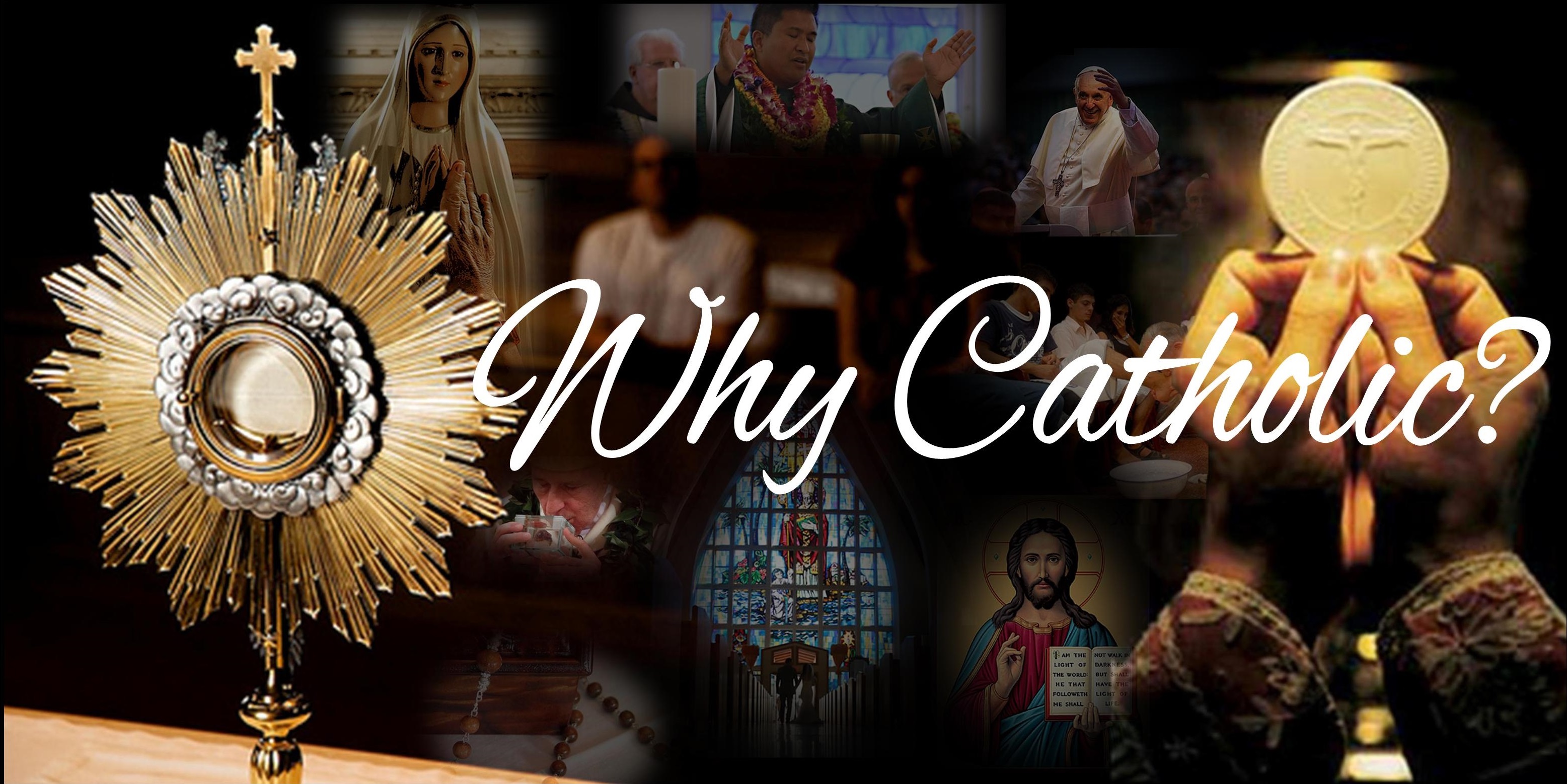
Why Be Catholic?


Dear Theophilous,

I’m what most people would consider a cradle Catholic, more or less. Shortly after I was born I was baptized at St. Anselm’s parish in Toronto. Even though it wasn’t their home parish, they had gotten married there, and thus the decision to have me baptized there. I don’t think any of us have ever been back to St. Anselm’s since.

I also have vague recollections of my sister’s baptism when I was 3, but most of my early childhood memories are of Sunday School at the local United Church. It wasn’t until I was 9 years-old and my mom went through the RCIA program that we started attending St. John Chrysostom and I made my first Reconciliation and Eucharist. From that point on, for all intents and purposes, was raised a cradle Catholic.

During those formative years, if you had asked me Why I was Catholic, I would have given the question about a 10-second thought before answering, “Because my parents are.” Actually, growing up in the Catholic school system, it just seemed natural that everybody and their parents (and their parents’ parents) were Catholic. It was just the natural order of things.

As I’ve been mellowing in my old age, however, I’ve been giving more and more thought to the question Why be Catholic? It’s a question I’ve heard discussed by a variety of different personalities on The Catholic Channel on SiriusXM, giving much food for thought. It’s a question I knew I had to answer once I saw it emblazoned on a banner in my mother-in-law’s parish in London, Ontario.

I know the answer, “Because my parents are,” will no longer hold water when it comes to defending my Catholic faith, so I narrowed it down to three key reasons:


  • The Eucharist
  • The Truth
  • My Family


The Eucharist

The Catechism of the Catholic Church rightly states that “The Eucharist is the source and summit of Christian life.” (CCC #1324) The Catechism tells us how all other sacraments, and all other life in the Church are bound up in the Eucharist and oriented toward it. How could they not be? This is the body and blood, soul and divinity of our Lord and Saviour. Really, the Eucharist is the be all and end all of what it means to be Catholic, and in my mind, what it means to be Christian.

Believing in the Eucharist isn’t easy. It never was. Even those who knew Christ and followed him daily had a hard time. During the Eucharistic Discourse in the Gospel according to St. John, when Jesus tells His followers they need to eat His flesh and drink His blood they grumble, “This is a hard saying; who can listen to it?” (Jn 6:60) And then when Jesus reiterated our need for the Eucharist, “many drew back and no longer walked with Him.” (Jn 6:66).

Knowing the Eucharist, understanding the Eucharist, loving the Eucharist; none of it is easy; but one you do, it is the most beautiful thing on Earth. I’ve heard it said that if we truly knew in our hearts what the Eucharist contained – wild horses could not keep us away from it. Some of the most profound moments in my life have come before the Blessed Sacrament, my heart physically pulled towards the Tabernacle; the ache of my suffering eased by the sacrifice on the altar; the tranquil warmth that fills me when I consume the Eucharist.

It is through the Eucharist that I love that I have come to know Christ’s love for me, a sinner.


The Truth

If the Eucharist is the source and summit of our faith, our faith hinges on a single question that Jesus asks us: “Who do you say that I am?” (Mk 8:29, Mt 16:15) How we answer that question changes everything. C.S. Lewis tells us we can answer this question in only in one of three ways: that Christ a liar, a lunatic, or He is Lord. Personally, I pick the third option each and every time.

Whenever defending doctrine or explaining a point of faith, I like to begin the discussion by asking this very question. The starting point with Christians is that He is Lord, God, one with the Father and the Holy Spirit. (If this isn’t the answer, there’s a whole other conversation that needs to take place). If Christ is God, then we have to take what He says as the Truth – like it or not.

Christ Himself tells us, “I am the way, the truth and the life.” (Jn 14:6) It’s not a boast – it’s a simple fact.

There are a lot of Christ’s teachings that are difficult, even more so now in the 21st Century than they were in the 1st Century (and look what they did to Jesus back then). When we propose that our truths are better than Christ’s, are we then not presupposing that we are greater than God?

The Truth that Christ gives us in His Gospel is like a beacon in the dark. The Truth guides us to the joy of eternal life in Him. The seas may be, and usually are, rough; but the guiding light of Christ’s love and Truth bring us to safety. Instead of binding us up, the Truth liberates us to not worry about the raging waters around us, but to take comfort in the safe harbour we are going to enter.


My Family

The joy of faith is not something to be kept in secret, a lamp hidden under a bushel basket; rather, it is to be shared freely. I love the expression: Don’t just keep the faith. Give it away!

I always teach my students that the true meaning of Love is “to want what is best for the other.” If I truly love my wife and if I truly love my son, how could I ever imagine to keep from them the beauty I have found in the Eucharist and the Truth? There is nothing I want more for them than the love of God.

This is how the faith has come down to us over 2,000 years. Passed from generation to generation, parent to child. I can’t think of any better gift I could give my son, a gift that will not only last a lifetime, but for all eternity.


Why Be Catholic? Is a question I had never given too much thought to, but it’s a question which defines who I am; who my family is.  This is a question I no longer run from, but embrace and am proud to answer.

Monday, August 17, 2015

Numbers and the Bread of Life Discourse


Dear Theophilous,

I’m not someone who superstitiously puts a lot of faith in numbers. I don’t play the lottery. I won’t go out of my way to avoid the number 13. I don’t really have a favourite or lucky number (although throughout my entire recreational athletic career I have worn the number 7, that’s due more to the fact that when selecting my first ever hockey jersey I chose the sweater with the captain’s C on the front in a moment of 6-year-old vainglory). It’s just that I feel life is too short to spend my time worrying about how the numbers in my life will affect how my day plays out.

All this being said, I do love finding symmetry and patterns in the world around me; something that usually involves number games. One of my favourite number games is to find numerical links throughout Holy Scripture. A few of which (both obvious and obscure) include:

3

The Holy Trinity
The number of persons involved in Original Sin
The number of times God called Samuel
The number of persons involved in the Transfiguration
The number of angelic visits during the Nativity story

12

Tribes of Isreal
Apostles
Elect for Paradise (12x12=144x1,000=144,000)

40

Years the Israelites wandered in the desert
Days that Elijah spent on his journey
Days Christ spent in the desert
Days between the Resurrection and the Ascension

This list is very incomplete. I’m sure there are biblical scholars that have spent their careers looking at these numbers, interpreting them, commenting on them and sharing the wisdom these numbers impart.

As we work our way through the Bread of Life Discourse (Year B – Weeks 17-21 of Ordinary Time), there is another numerical coincidence that I find interesting, to say the least.

As a highlight of his teaching through the entire Bread of Life Discourse Jesus tells the crowds (and us):

Very truly, I tell you, unless you eat of the flesh of the Son of Man and drink his blood, you have no life in you. Those who eat my flesh and drink my blood have eternal life, and I will raise them up on the last day; for my flesh is true food and my blood is true drink. Those who eat my flesh and drink my blood abide in me, and I in them. Just as the living Father sent me, and I live because of the Father, so whoever eats me will live because of me. This is the bread that came down from heaven, not like that which your ancestors ate, and they died. But the one who eats this bread will live forever. (Jn 6:53-58)

The Bread of Life Discourse remains as difficult to swallow today as it was in the time of Christ:

Then the Jews began to complain about him because he said, “I am the bread that came down from heaven.” (Jn 6:41)

The Jews then disputed among themselves, saying, “How can this man give us his flesh to eat?” (Jn 6:52)

When many of his disciples heard it, they said, “This teaching is difficult; who can accept it?” (Jn 6:60)

Because of this many of his disciples turned back and walked with him no longer. (Jn 6:66)

It was during my meditation on the Bread of Life Discourse a couple of years ago that this last line caught my attention for it’s numeric value, for which I feel it bears repeating, but with a slightly different emphasis:

Because of this many of his disciples turned back and walked with him no longer. (Jn 6:66)

I doubt that it would take much commentary to make the link between the Scripture context and its numeric value. Disciples no longer walking with Christ in a verse numbered 6:66 … a number associated with Satan (the Beast) in the Book of Revelation (cf Rev 13:18). It is Christ who calls us to abide in Him through the Eucharist, His very flesh and blood; and Satan who pulls us away.

More telling is the exchange Jesus has with His Apostles immediately after the other disciples left Him:

“Do you also wish to go away?” (Jn 6:67)

To which Simon Peter replied:

“Lord, to whom can we go? You have the words of eternal life.” (Jn 6:68)

Through His loving grace the Father has given us the gift of freewill. When Christ calls us to Him in the Eucharist it is for us to decide whether we will fall away and walk with Him no longer, or will we turn to Him because He has the words of eternal life.

Monday, February 17, 2014

Parents as First Evangelists


Dear Theophilus, 

Home is where the heart is. Home is also where the seeds of Christ are sown. Home is the first line of evangelization. Home is the Ecclesia Domestica. 

This has never been more apparent to me than this beautiful long weekend where Canadians (at least in Alberta, Ontario and Saskatchewan; according to my calendar) celebrate Family Day. Although we usually try to incorporate activities with our extended families on this weekend, this year we’ve also relished in the blessing of having the whole weekend to our immediate family. Each of us has had time to follow our own personal pursuits (writing this blog for example), while we’ve also come together for some great quality time both indoors and out. 

I always marvel at how God works in our lives, and this weekend has been no different. Our Family Day weekend began on Thursday night as my wife and I were able to attend a seminar at our parish on How to Raise Catholic Children – which our pastor aptly renamed: How to Raise Children Catholic. Fr. Charles’ talk could be summed up in one word: Eucharist. The source and summit of our faith must also be the source and summit of our family lives. 

This is where the role of parents as first evangelists, the Ecclesia Domsetica, comes in. 

As good friend PatrickSullivan puts it so well when talking to the parents of children preparing for First Reconciliation and First Communion: “Children love what their parents love. If parents love sports, then their children will love sports. If parents love the pursuit of wealth, then their children will love the pursuit of wealth. If parents love Christ, then their children will love Christ.” 

It warrants being repeated: 

If parents love Christ, then their children will love Christ. 

And children are not stupid either. They see and know the difference between what is said and what is. Too many parents will tell their children that God is important; that’s why they have their children sacramentalized like a religious checklist and drag them to church for Christmas and Easter; yet they do not live out the love of God the other 50 weeks of the year or in their daily lives. Children see this. Children understand this. 

Too often parents tell their children, “Do as I say, don’t do as I do.” Unfortunately, children would much rather do as their parents do. Parents would rather point to someone else, a saint, the parish priest or a Catholic school teacher; rather than take on the responsibility of evangelization themselves. Evangelization is hard work, particularly when the rest of society (especially in the media) tells you different. Parenting too is hard work, but through their own baptism evangelization must also be the parent’s first responsibility to their children. 

Parents must sow the seeds of Christ through the evangelization of their children. Once parents find the unbridled joy of the Eucharist, they will want nothing more than to share this with their children. Children who witness their parents fervently participating in the Eucharist (this does not necessarily mean taking an active role in ministry, but rather taking an active, prayerful role in the Mass), will want to come to know and participate in the Eucharist as well. Children who learn to love the Eucharist from an early age will garner a wisdom deeper than many adults, and they will grow to see the image of God in each human individual, treating them with the dignity that Twenty-First Century humanity so desperately craves.

Friday, January 10, 2014

Every Mass is like High Mass


Dear Theophilus,

As a family we like to start school breaks (Christmas and summer) with a little get-a-way. We find our holidays to be more relaxing because there is a distinct break between work and down time with the forced relaxation that a hotel stay brings. It’s nothing extravagant, just a couple of nights in a hotel with a pool in downtown Toronto, with someone to make the beds, cook meals and do the dishes for few days.

Each year one of the highlights is attending High Mass at St. Michael’s Cathedral.

One of the reason’s my son likes going to the cathedral because his name is also Michael, so he feels a certain link with the church, like it’s his very own. He also likes looking for the Archbishop’s tasselled hat hanging above the altar. And the look of awe in his eye when he saw Thomas Cardinal Collins processing in was only matched by his excitement when he realized we would received communion from his Eminence.

Personally, I find a certain enchantment with the sacred beauty that Mass at the cathedral entails. There is all of the sacred art – murals, stained glass, the gold gilded tabernacle; which all focus the mind towards God (unfortunately all hidden behind restorers’ scaffolding on our December visit). When the 100-voice strong choir from the acclaimed St. Michael’s Boys’ Choir School sang the Gloria, I closed my eyes and imagined that this must be as close as earthly possible to the Angels’ refrain on the night of the Nativity. Added to this was the sweet scent of incense, and I felt that I was participating in something sacred.

I was so moved and excited by the whole experience, shortly after Mass I sent a text message to a friend: High Mass at the Cathedral with the Cardinal. AWESOME!!!!!!

To which he replied: Very cool … our Mass parish priest … no power … still awesome …


I was dumbfounded. He was so very right! Yes, all the sacred beauty and enchantment of the cathedral Mass are wonderful, but what is truly awesome, the source and summit of our faith, is the Eucharist. Whether it is celebrated on the altar of the humblest of chapels or under the Dome of St. Peter’s in Rome, the core of the Mass is the same. We are called to partake in Christ’s sacrifice in the Eucharist. AWESOME!!!!!

Thursday, July 11, 2013

Making Prayer Personal


Dear Theophilus, 

Our God is a living God. 

If we cannot or do not believe in the Resurrection, then our belief in Christ is not only in vain (cf 1 Cor 15:1-2), but outright heretical. For if Jesus did not rise from the dead then he is not the Messiah, the Son of the Living God. 

As Christians we are called to have an intimate relationship with God through Jesus Christ. But how can we build up this relationship so that it is vibrant, joyful and life-giving? 

The answer is quite simple, the key to having a vibrant relationship with God is the same as our relationships with others: good communication. Where our human communication can take on many forms (conversations, e-mail or text), we communicate with God through prayer. 

Prayer is turning the heart toward God. When a person prays, he enters into a living relationship with God. (Youcat 469; CCC 2558-2565) 

The notion of entering a relationship with God through prayer opens up a whole intimate and personal dimension. Just like there is a personal dimension in all of our human communications (yes, there’s even business letters have a level of personal investment), there is a personal element in how we communicate with God.  

We need to make prayer personal. 

I’m not stating that there needs to be a dramatic shift from a public prayer life to a predominantly private prayer life. Rather, what I am saying is that there is a need to develop a deep personal investment in our prayer life as a whole. There must be a balance found between both public and private prayer life, each feeding off of and into the other, and both stoking the deep, personal and intimate relationship that we have with God. 

The question arises then of how do we do this? How do we make prayer personal? Especially when it’s our private prayer that seems deeply intimate (our nighttime prayers and personal supplications before God), while our public prayer seems dry and remote (usually responding by rote at Mass). It won’t be easy and will take some effort, but like all things in this life, when we put in the effort to deepen our relationship with God, the rewards will be exponential. 

At this point I’d like to put forward the very non-scientific argument that the overwhelming majority of practicing Catholics (i.e.: those who attend Mass on a regular basis, beyond Easter, Christmas and family celebrations) only have a public prayer life. They attend Mass on Sunday and leave feeling they’ve met their end of the bargain in their relationship with God. My experience is that many of these people don’t have a very strong private prayer life, and thus feel that their relationship with God is lacking somewhat. Often these very same people will ask me how they can engage their children in the Mass, to which I reply with some rhetorical questions (I make sure they understand I don’t want or need to hear their answer, I just want them to reflect on the questions): What is their prayer life like at home? Do they incorporate prayer in their daily routine? Do they make a habit of frequenting the sacraments (Eucharist and Reconciliation)? 

As for those who don’t go to Mass regularly (or at all) many will argue that they don’t need to go to have a relationship with God; that they can communicate with God any time they see fit or need Him. Here I would argue that most of these people don’t even have this personal relationship with God that they claim to have, mostly because they see themselves as the centre of this relationship and not Christ. 

Again the question comes up: How do we make prayer personal? How can we get our public prayer to the next level and enrich our private prayer so as to deepen our relationship with God?

For myself, it started with going beyond the rote responses at Mass. It took a concerted effort to concentrate on what was being said and sung and seeing how it related to me in my life at that particular moment. It was done in baby steps. I didn’t take on the whole Mass all at once. I began with closing my eyes and focusing on the words of the Gospel. Once I had mastered concentrating on the Gospel, I added the readings. Soon I was able to make the connections between the Old Testament and New Testament readings. Over the years I’ve been doing this I’ve slowly added a new part of the Mass to concentrate on with the others, to the point where I spend most of the Mass contemplating on what is happening and being said. 

The Mass, a very public prayer, has also become a very personal prayer. 

Since I’ve been doing this, my private prayer life has also grown. With the natural ebb and flow of any personal relationship (with my relationship with God this is all due to my own failings), I have added new aspects to my prayer life. Some of these are traditional rote prayers: daily Rosary or prayers before every meal; while others are more fluid in nature: personal supplications or a daily examination of conscience. 

What I have found is that by making prayer personal, my relationship with God has grown deeper and strengthened my resolve in Christ.

Monday, June 24, 2013

The Quintessential Question of our Faith


Dear Theophilus,

In this past week’s Gospel reading (Lk 9:18-24), Christ asks the quintessential question of our faith:

“Who do you say that I am?” (Lk 9:20)

Our entire faith hinges on how we answer this very pointed question.

If, like Peter, we answer: “The Christ of God.” (Lk 0:20), then everything else should fall neatly into place. There can be no further questioning of our faith. There certainly should be no further questioning of what we believe in or how we act morally and theologically.

Christ is asking us to either accept him for all that he is, or to reject him.

It’s on this question that the arguments of our Christian brethren that feel they can pick and choose Christ’s teachings that are relevant to them begin to fall apart. For, if they cannot accept all that Christ teaches, then how can they consider him to be The Christ of God?

How can we not consider the Eucharist to be the source and summit of our faith when Christ told us “I am the living bread that came down from heaven. Whoever eats of this bread will live forever; and the bread that I will give for the life of the world is my flesh.” (Jn 6:51) if he is not The Christ of God?

If Jesus is truly The Christ of God, then how can we not consider the teaching of the Catholic Church to be divinely inspired when, appearing to the disciples after the Resurrection, Jesus said to them “’Peace be with you. As the Father has sent me, so I send you.’ When he had said this, he breathed on them, (Jn 20:21-22) a commissioning that continues to this day in the conferring of the sacrament of priesthood. A priesthood in the Catholic Church commissioned when Christ said: “You are Peter, and upon this rock I will build my church, and the gates of Hades will not prevail against it.” (Mt. 16:18)

The teachings simply fall into place once we truly understand what it means to answer Christ’s question like Peter did at his institution as the fist Pope: “You are the Messiah, the Son of the living God.” (Mt. 16:16)

The list of what becomes indisputable when we answer this question, Who do you say that I am? is too lengthy to discuss in a blog post, there are 2865 paragraphs in the Catechism of the Catholic Church. It’s all there, and if Jesus is The Christ of God, then each of those paragraphs makes perfect sense.

As Fr. Robert Barron puts it so well (as he always does) in his Catholicism Series, if we do not answer like Peter, then there is very little to differentiate Christianity from the other world religions. If Jesus is not The Christ of God, then he is little more than a prophet, like Elijah or Mohammed, who have had (or claimed to have had) a revelation from God. If Jesus is not The Messiah, the Son of the living God, then he is little more than a new Buddha who has fond another path towards enlightenment. If Jesus is not The Christ of God, then could he be the next incarnation of Vishnu, come to teach us how to attain Moksha?


This is the quintessential question of our faith. How you answer it forms the core of what you believe and compels you how to act on those beliefs. So,…

Who do you say that He is?

Monday, January 28, 2013

Putting on our Sunday Best


Dear Theophilus,

When it comes to special occasions, we’re often told that we need to dress in our Sunday Best. Unfortunately, I’m not sure if Sunday Best is still what people take it to mean. As I take a look around the congregation on Sunday mornings, the fashion styles run the gamut from backyard comfortable and weekend lounging to business casual and almost semi-formal.

I’ve also noticed (these are my own observations and in no way should be taken as the findings of a scientific study) a certain correlation between the age of an individual and how they dress for Mass, with younger members of the congregation dressed as though they were on their way to hang out at the mall – as though they had negotiated their clothing choice with their parents in exchange for attending Mass. It seems, however, that the casual dress code seems to continue into young adulthood for those who choose to continue going to Mass on their own. A second observation, and it’s been made to me by parishioners in this demographic, is that members of the congregation who have recently arrived in Canada or are first-generation have a tendency to dress truly in their Sunday Best for Mass.

The beauty of Catholicism is that they are there in the pew, accepted by God for who they are and the love they bring for Him. All are welcome at the Lord’s table, and all who ask will be nourished.

But do we truly understand the nourishment we’re asking for, and do we truly understand the table the Lord has invited us to?

How many of us, when we’re invited to a dinner party or go out to a high-end restaurant, take the time to primp and preen, paying special attention to our appearance? We tell ourselves that it’s a special occasion, and that we need to look the part to be able to enjoy the whole experience. Although the meal may be the focal point, but our preparation for the meal, inside and out, heightens our expectations and delights in taking part in such a special occasion.

How much more special is the meal we are called to each Sunday? How sacred is the beautiful gift of the Eucharist to us? How should we prepare ourselves to meet Christ at His table?

The Body of Christ is the only food in creation that does not become absorbed by the one eating it; it is the person partaking of the Body of Christ that is absorbed by him. In the Eucharist, Christ is not humbling himself to become food for us; rather, he is elevating us to himself so that in eating his flesh we can become more like him. How very lucky we are to receive an invitation to this banquet.

So we need to prepare. We need to make ready our minds, our hearts and our bodies to receive the Eucharist. And knowing what a wonderful supper we are invited to, should we not present ourselves to our gracious host, our Lord and God, in our Sunday Best?